
Importing a car from the USA: what you need to know in Hungary
Customs duty, VAT, registration tax and approval. And why a single emissions document can decide hundreds of thousands of forints.

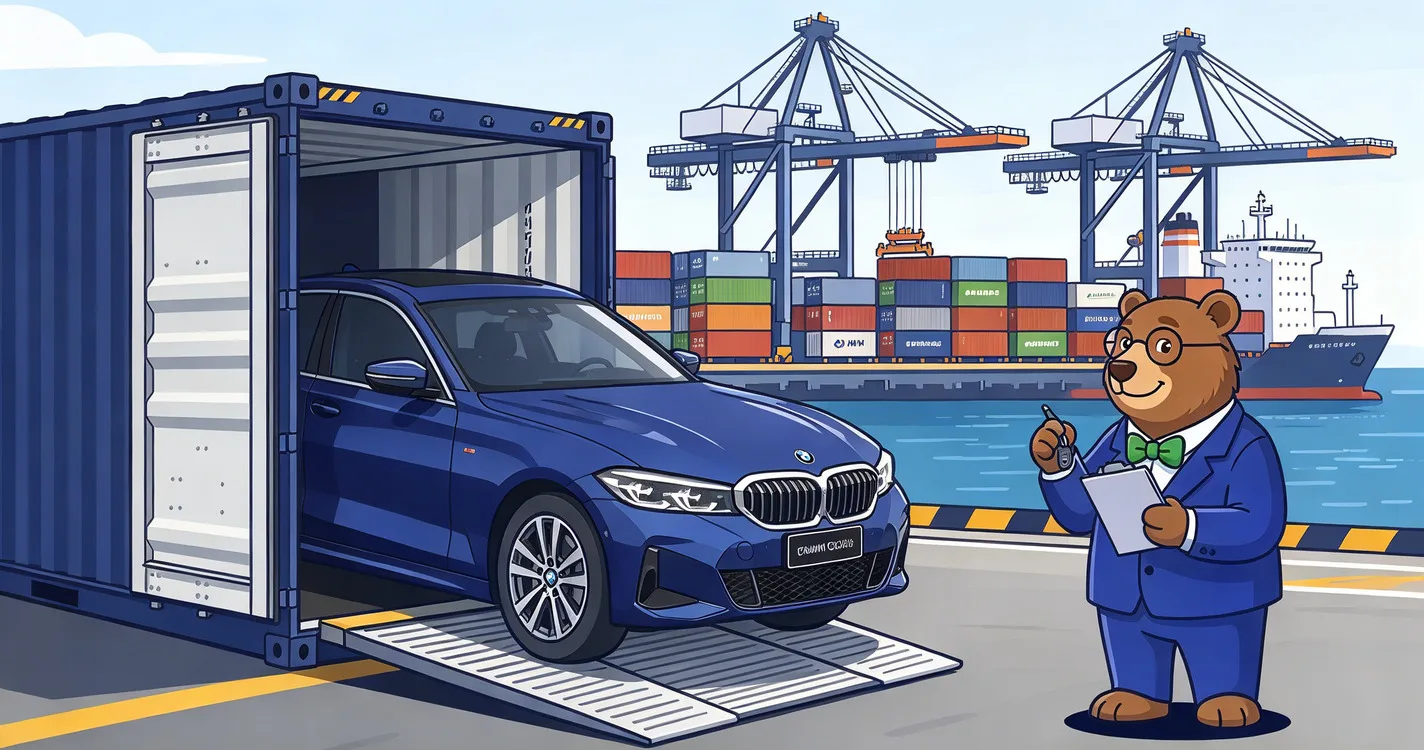
A car from a US auction often looks like a good buy. But the auction price is only the start. Before you get Hungarian plates, you pay for transport, customs duty, VAT, approval and registration tax. And sometimes for a history nobody told you about.
This guide shows what an import really costs in 2026, which steps follow one another, and what to check before you bid.
In short
- You pay 10% customs duty and 27% VAT, the highest VAT rate in the EU. From 1 July 2026 the duty on cars built in the USA can be 0%, if you prove the origin.
- The biggest item is the registration tax (regisztrációs adó). It depends on the engine power and the emissions class.
- Without a European emissions certificate the car can land in the worst class, and the tax multiplies.
- If the date of first registration is not on record, you lose the age discount.
Jump to: check the vehicle history·cost example·compare 12 countries
What did it go through in the US?
Once a car is registered here, its US past is easy to hide. The VIN still shows it: auction photos, damage records and title brands.
Example: WBA3A5G59DNP26082Free preview included
- 30+ countries
- Result in under a minute
- Full PDF report
Customs duty, VAT and registration tax
Everything starts from the customs value: the purchase price plus transport and insurance to the EU border. On passenger cars the duty is usually 10%. The 27% VAT is added on the customs value plus the duty.
New since 1 July 2026: EU Regulation 2026/1455 cuts the duty on goods of US origin to 0%, for now until the end of 2029. Passenger cars are included. What counts, though, is where the car was built, not where you bought it. A car built in Japan or Mexico still pays 10%, even if you bought it at a US auction. According to the European Commission, a "Made in USA" sticker or a line on the invoice is not enough proof. For a used auction car this is hard to prove, so plan with 10%.
The registration tax is the big Hungarian item. Since March 2025 it is calculated from the engine power (kW): a multiplier, the 2026 base amount of HUF 47,000 and an age discount. The multiplier comes from the emissions class. Classes better than 2 need a European or UNECE emissions approval. Without one, the US car can land in the "8 or worse" column. And if the date of first registration is not on record, there is no age discount either.
On top you pay the property acquisition duty (vagyonszerzési illeték) based on kW, and the annual motor vehicle tax, which also applies to private cars.
Cost example: a 2018 saloon
Say you buy a 2018 saloon with a 2.0 petrol engine and 118 kW for USD 12,000 and pay USD 1,800 for shipping to an EU port. The tax procedure starts in November 2026, about 100 months after the first registration.
| Customs value (price plus transport) | USD 13,800 |
| Duty 10% | USD 1,380 |
| VAT 27% | USD 4,099 |
| Total import taxes | USD 5,479 |
| Registration tax, Euro 6 proven, date on record | HUF 36,660 |
| Registration tax, no emissions certificate | HUF 586,560 |
| Registration tax, no certificate and no date | HUF 2,256,000 |
Customs uses its own exchange rate. With accepted US origin (0% duty) the import taxes come to USD 3,726. Not included: auction fees, transport in the USA and Europe, customs agent, conversion, tests, duty, motor vehicle tax and insurance.
Port and customs clearance
Hungary has no seaport. US cars usually arrive in Bremerhaven, Hamburg, Rotterdam, Antwerp or Koper and travel on from there. There are two routes: the car travels under customs transit to a Hungarian customs office and is cleared there, or it is cleared in the port country. If it is cleared in Germany with 19% VAT, you generally do not pay the VAT again in Hungary for a used car, but you do pay the registration tax.
Approval for Hungarian registration (honosítás)
A US car has no European certificate of conformity, so it must go through the honosítás approval. The order is: origin check, authenticity inspection, pre-registration technical test, registration tax at the tax authority (NAV), and finally registration at the government office (kormányablak). At the technical test the car gets its emissions class, which goes on the technical data sheet.
Since July 2025 private test stations can also carry out the approval. According to the draft, though, cars from outside the EU, such as the USA, would still have to go to a state station, so ask beforehand. Under the Hungarian rule the turn signals may show amber light only, so red US rear indicators must be converted.
Salvage, rebuilt, flood: damaged cars
Many cheap US cars come with a salvage, rebuilt or flood brand: an insurer has already written them off as a total loss, or they stood in water. We found no Hungarian rule that excludes these US brands. The car must still pass the authenticity inspection and the technical test like any other.
The test looks at the condition on the day: chassis number, body, airbags, brakes. It does not look at the quality of the repair or at the history of the car. Flood cars often show their faults in the electronics only months later.
The Hungarian registration certificate will not tell you that a car was a total loss in the USA.
That is why step 2 matters so much: check the US history before you bid, not after.
Our guide to checking the history of an imported car shows what else can get lost when a car crosses a border.
Step by step: from the listing to your own driveway
This is how an import works in practice. The times are indicative, not official deadlines. Plan roughly six to ten weeks for the whole process.
Set a budget and choose the car
before you buyAdd shipping, duty, 27% VAT, approval and registration tax to the auction price. The multiplier is higher for more powerful cars.
Check the VIN
before you bidAsk for the VIN and look at the US history before you bid:
- salvage, rebuilt or flood brands,
- auction photos and damage records,
- odometer readings over the years,
- the country of manufacture. A VIN starting with 1, 4 or 5 usually means a car built in the USA.
Clarify the emissions class
before you bidAsk the test station or an expert what document would give the car the class 15 that matches Euro 6. This one question can decide hundreds of thousands of forints.
Bid and buy
auction daySet your maximum bid including all fees. Pay only when you receive the original Certificate of Title, and keep the invoice and the proof of payment.
Transport and shipping
2 to 4 weeksThe shipping agent collects the car, takes it to the US port and handles the export. Choose the EU port: Bremerhaven, Hamburg, Rotterdam, Antwerp or Koper.
Customs clearance
on arrivalThe customs agent prepares the customs declaration and you pay the duty and the VAT. For 0%, prepare proof of US origin and of direct shipping.
Transport to Hungary
after clearanceThe car usually comes on a trailer or a transporter, because as a Hungarian resident you may not drive a car with foreign plates.
Conversion
usually a few days to 2 weeksUsually needed:
- amber rear turn signals,
- amber front side marker lights,
- a rear fog light,
- E-marked headlights and a speedometer in km/h.
Origin check and authenticity inspection
1 to 2 visitsThe authority checks that the car is not on the list of stolen or wanted vehicles, then the authenticity inspection looks at the chassis number and the body identifiers.
Pre-registration technical test
1 visitThe station inspects the car and issues the technical data sheet with the emissions class. Bring all the emissions papers.
Registration tax and registration
1 to 2 visitsPay the registration tax based on the NAV decision. Take out compulsory third-party liability insurance, then at the government office you receive the registration certificate, the vehicle title and the plates. Ask beforehand whether the US documents need an official translation.
Plates on, ready to go
doneThe property acquisition duty is assessed afterwards, and you pay the motor vehicle tax every year. Keep all the US documents: when you sell, a documented history is an argument for honest buyers.
Before you bid
Check the US history
Auction photos, damage, brands and odometer readings from more than 30 countries, in one report.
- 30+ countries
- Under a minute
- Full PDF report
Not sure yet? See what a full report looks like first
Good to know
- Plug-in hybrids: since January 2025 they are no longer exempt from the registration tax. Fully electric cars still pay no registration tax.
- Calculator: the tax authority website has a registration tax calculator that helps you work out the amount in advance.
- Foreign plates: as a Hungarian resident you may not drive a car with foreign plates in Hungary, so do not put off the approval.
- Buying in the EU instead? A car bought inside the EU pays no customs duty and no import VAT at the border. National taxes and registration costs still apply. Our guide to importing a used car to Hungary explains that route.
Importing from the USA to another country?
Customs duty is the same everywhere in the EU. VAT, registration tax and the approval rules are not. Choose a country to read its guide.
- BulgariaVAT 20%, product fee, legalised translations
- CroatiaVAT 25%, PPMV tax by CO2
- CzechiaVAT 21%, no registration or road tax
- FranceVAT 20%, CO2 malus, RTI approval
- GermanyVAT 19%, no registration tax
- HungaryVAT 27%, registration tax by emissions class
- ItalyVAT 22%, IPT, superbollo over 185 kW
- LatviaVAT 21%, no registration tax
- NetherlandsVAT 21%, BPM by CO2
- PolandVAT 23%, excise 3.1% or 18.6%
- RomaniaVAT 21%, no registration tax
- SlovakiaVAT 23%, low registration fee
Frequently asked questions
How much is the customs duty on a US car?
Usually 10% on the price plus transport to the EU. From 1 July 2026 the duty on cars built in the USA can be 0%, if you prove the origin. The 27% VAT is always added.
What does the registration tax depend on?
On the engine power (kW), the emissions class and the age of the car. Without a European emissions certificate the US car can land in a bad class, which multiplies the tax.
Is it worth clearing customs in Germany?
There the VAT is 19% instead of the Hungarian 27%, and for a used car you generally do not pay VAT again in Hungary. The registration tax you pay at home in any case.
Can a car with a salvage brand be approved?
We found no rule that excludes it. The car must pass the authenticity inspection and the technical test. Check the US history before you buy.
Sources
- Regulation (EU) 2026/1455, Annex I (chapter 87)
- European Commission, Access2Markets: new duties on goods from the USA from 1 July 2026
- Act CX of 2003 on the registration tax
- NAV: registration tax rates from 1 January 2026
- NAV: changes to the registration tax procedure
- NAV: registration tax calculator
- Decree 6/1990 (KöHÉM) (emissions classes, lighting)
- Government Decree 168/2025 (approval at private test stations)
- Act XCIII of 1990 on duties
Position as of October 2026. Agree the fees and the practice of the test station in advance.
Read next