
Importing a car from the USA to Europe: what it costs in 12 countries
The customs duty is the same everywhere in the EU. The final bill is not. VAT, registration tax and the approval rules decide what a US car really costs where you live.

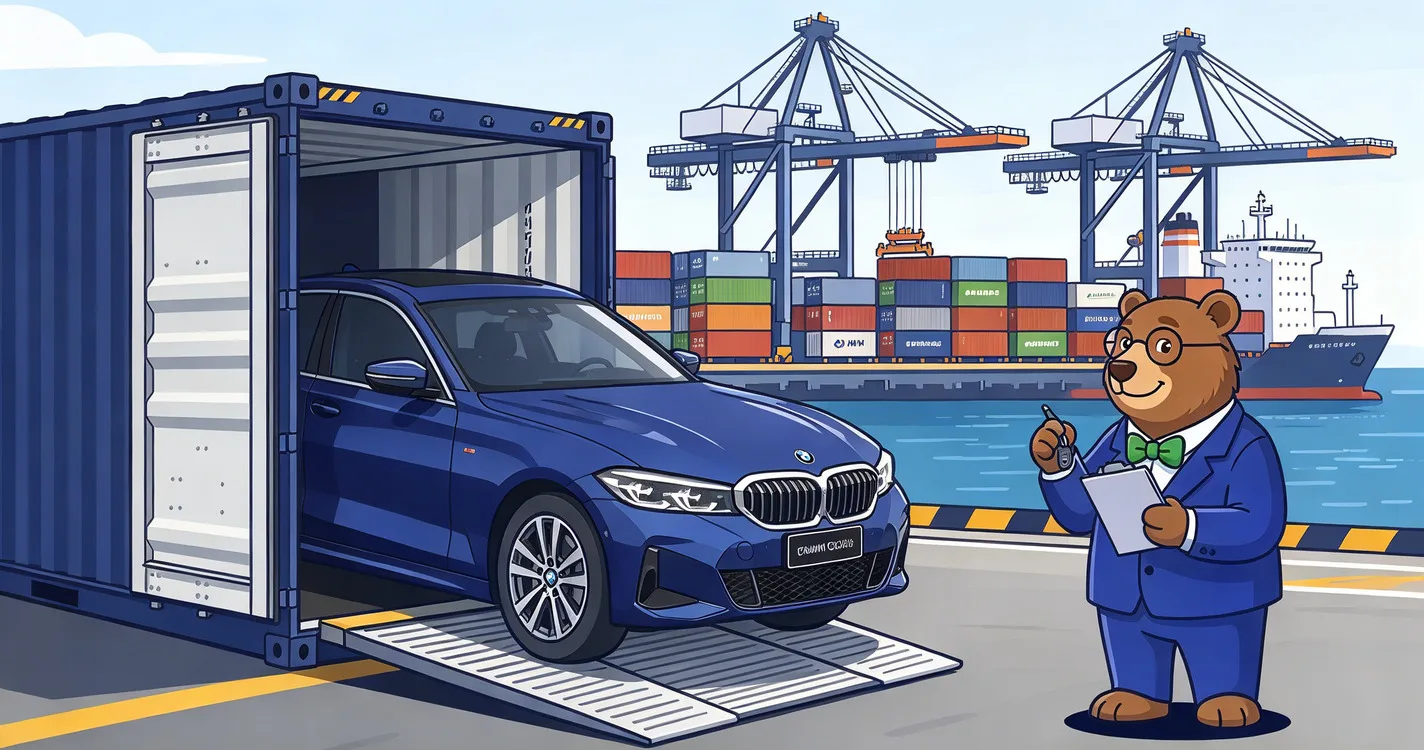
A car from a US auction can look like the deal of the year: a huge choice, low hammer prices, models that are rare in Europe. But the price you bid is only the start, and how much comes on top depends almost entirely on the country where the car will be registered.
We wrote a detailed import guide for 12 EU countries. This page puts them side by side: what every importer pays at customs, how the same car is taxed in each country, how long the journey takes, and where a car's US history tends to disappear.
In short
- Every EU country charges 10% customs duty on a used car from the USA. Since 1 July 2026 it can drop to 0% for cars built in the USA, but you have to prove where the car was built.
- Import VAT is charged on the price, the freight and the duty, at the national rate. It runs from 19% in Germany to 27% in Hungary.
- The biggest differences come after customs. Without accepted CO2 or emissions data, the registration tax in the Netherlands, Croatia or Hungary can cost more than the car itself.
- Some countries refuse to register a car declared a total loss in the USA, and some record nothing at all. Check the US history before you bid.
What did it go through in the US?
Once a car is registered in Europe, its US past is easy to hide. The VIN still shows it: auction photos, damage records and title brands.
Example: WBA3A5G59DNP26082Free preview included
- 30+ countries
- Result in under a minute
- Full PDF report
What every importer pays at customs
Customs starts from the customs value: the price you paid plus transport and insurance to the EU border. On a passenger car the duty is normally 10% of that. Import VAT is then charged on the customs value plus the duty, at the rate of the country where the car is cleared. As a private buyer you cannot reclaim it.
New since 1 July 2026: EU Regulation 2026/1455 cuts the duty on goods of US origin to 0% until the end of 2029, and passenger cars are included. What counts is where the car was built, not where it was sold. A Japanese or Mexican built car auctioned in California still pays 10%.
To get 0% you have to prove the US origin, and a line on the invoice is not enough. Used auction cars often lack that proof, so plan with 10% and treat 0% as a bonus. A VIN starting with 1, 4 or 5 usually means the car was built in the USA, but that is a filter, not proof.
You can clear the car in any EU country, for example in Bremerhaven or Rotterdam, and register it at home. The VAT is then paid where the car is cleared. The registration tax and the approval still follow the country where the car will be registered.
The same car in 12 countries
This is what changes from country to country once the duty is paid. Each country links to its full guide, with the cost example, the approval process and every step to registration.
| Country | Import VAT | What comes on top | Watch out for |
|---|---|---|---|
| Bulgaria | 20% | Product fee by age, about €148 for a 5 to 10 year old car | Every foreign document needs a legalised translation |
| Croatia | 25% | PPMV special tax, set by CO2 and price | Without CO2 proof, 401 g/km is assumed: about €12,542 instead of €949 |
| Czechia | 21% | No registration tax and no road tax on private cars | Individual technical approval is still required |
| France | 20% | CO2 malus and the regional registration tax | Individual approval (RTI) with UTAC tests can cost thousands of euros |
| Germany | 19% | No registration tax, only the annual car tax | No approval without tyre pressure monitoring |
| Hungary | 27% | Registration tax by power and emissions class | Without an emissions certificate the tax can be sixty times higher |
| Italy | 22% | IPT, plus superbollo every year above 185 kW | Apostille and sworn translations of all US documents |
| Latvia | 21% | No registration tax, natural resources tax of €110 | A salvage certificate is not accepted as a registration document |
| Netherlands | 21% | BPM, set by CO2 | Without a recognised CO2 value: about €49,757 of BPM instead of €5,217 |
| Poland | 23% | Excise duty: 3.1% up to 2.0 litres, 18.6% above | Some registration offices hesitate over cars from outside the EU |
| Romania | 21% | No registration tax | No vehicle identity card for a declared total loss |
| Slovakia | 23% | Registration fee by power, €90 for a 118 kW car | Individual approval costs €300 plus a technical service report |
Figures from each country guide, October 2026. The PPMV and BPM figures are for the same 2018 petrol saloon used in every guide.
What customs charges on a 2018 saloon
Every guide uses the same example: a 2018 saloon with a 2.0 petrol engine, bought for USD 12,000 with USD 1,800 of shipping. The customs value is USD 13,800. This is what customs collects in each country, before any registration tax.
| Country | 10% duty plus VAT | With proven US origin |
|---|---|---|
| Germany | USD 4,264 | USD 2,622 |
| Bulgaria and France | USD 4,416 | USD 2,760 |
| Czechia, Latvia, Netherlands and Romania | USD 4,568 | USD 2,898 |
| Italy | USD 4,720 | USD 3,036 |
| Slovakia | USD 4,871 | USD 3,174 |
| Croatia | USD 5,175 | USD 3,450 |
| Poland, with 3.1% excise | USD 5,450 | USD 3,700 |
| Hungary | USD 5,479 | USD 3,726 |
Between the cheapest and the most expensive country there are about USD 1,200 at customs. After customs, registration taxes can open a far bigger gap: in the Netherlands the BPM on this car is about €5,217 with an accepted CO2 value and about €49,757 without one.
Customs converts at its own monthly rate. Not included: auction fees, transport inside the USA, port and agent costs, conversion, approval, registration and insurance.
From the auction to your driveway
The steps are the same in every country, and so is the order that saves money.
Set a budget
before buyingAdd roughly a third to the auction price for transport, duty, VAT and conversion, then your country's registration tax. Models also sold in Europe are usually cheaper to approve.
Check the VIN
before you bidLook for title brands such as salvage, rebuilt or flood, auction photos, damage records and mileage readings. Check where the car was built if you hope for 0% duty.
Ask whether it can be approved
before you bidSend the model, year and specification to the testing body in your country and ask what the car needs. A no at this stage saves thousands.
Bid and buy
auction daySet your maximum bid including every fee. Only pay against the original title, with a lien release if a bank is still named on it.
Ship the car
1 to 4 weeks plus the crossingA forwarder takes the car to the port and files the export. The crossing takes about 10 to 18 days from the East Coast and 3 to 5 weeks from the West Coast, depending on the port.
Clear customs
after arrivalPay the duty and the import VAT and keep the customs document. Without it no country will register the car.
Convert, approve, register
the last few weeksLights, indicators and speedometer are converted to EU rules, the car passes the national approval, and you register it with the documents your country asks for.
Allow roughly six to ten weeks from the auction to registration.
Where the US history disappears
Many cheap US cars carry a salvage, rebuilt or flood title. An insurer has written them off, or they stood in water. What happens to that history in Europe depends on the country.
- Germany records US salvage titles neither at import nor at registration. A repaired wreck gets the same papers as an accident free car.
- Romania: RAR does not issue a vehicle identity card for a car declared a total loss, scrapped or sold for parts.
- Latvia: a document stating that a car is written off or cannot be repaired is not accepted as a registration document.
- The Netherlands: after flood damage, a damage inspection is always required.
- Poland and Czechia: the national record starts with the first inspection in the country. Damage from the USA only shows in the US history.
A European registration document has no field for a US title brand. The history survives only in the records attached to the VIN.
That is why the VIN check comes before the bid, not after. It shows auction photos, damage records, title brands and mileage readings, so you know what you are bidding on.
Our guide to checking the history of an imported car shows what else can get lost when a car crosses a border.
Before you bid
Check the US history
Auction photos, damage, title brands and mileage readings from over 30 countries, in one report.
- 30+ countries
- Under a minute
- Full PDF report
Not sure yet? See what a full report looks like first
Frequently asked questions
How much duty do I pay on a car from the USA?
10% of the price plus transport to the EU, in every EU country. Since 1 July 2026 it can drop to 0% for cars proven to be built in the USA. Import VAT at your national rate always comes on top.
Which EU country is cheapest for importing a US car?
At customs, Germany, with 19% import VAT. After customs, countries without a registration tax, such as Germany, Czechia, Latvia and Romania, keep the total lowest. The Netherlands, Croatia and Hungary can be very expensive without accepted CO2 or emissions data.
Can I clear customs in one country and register the car in another?
Yes. Many buyers clear the car in Bremerhaven or Rotterdam and pay that country's VAT. The registration tax and the approval still follow the country where you register the car.
Can I register a car with a salvage title in Europe?
It depends on the country. Germany registers it if it passes the approval, Romania refuses a car declared a total loss, and Latvia does not accept a salvage certificate as a registration document. Check the history before you buy.
Sources
- Regulation (EU) 2026/1455, Annex I (chapter 87)
- Council of the EU: final approval of the tariff commitments, 25 June 2026
- Bundestag, hib 549/2025: salvage titles on US imports
- ADAC: importing from the USA and Canada
- The 12 country guides linked above, each with its own national sources
As of October 2026. Figures come from the national guides and their official sources.
Read next