
Importing a car from the USA: what you need to know in Germany
Customs duty, import VAT, the TÜV approval and registration. And why a car's history can get lost on the way across the Atlantic.

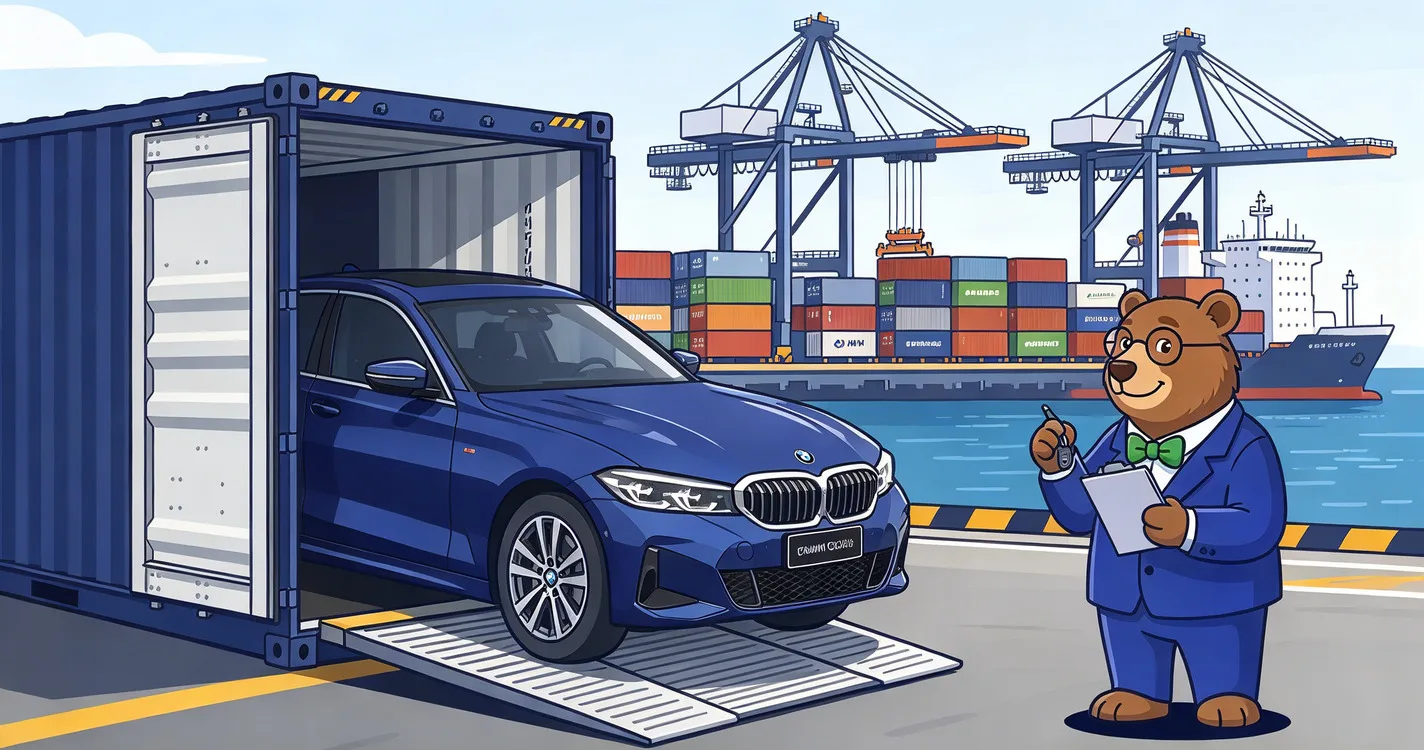
A car from the USA often looks like a bargain: a huge choice, low auction prices, models you rarely see here. But the auction price is only the start. Before the car wears German plates, you add customs, tax, conversion work and inspection. And often a history nobody mentions.
This guide shows what a private import really costs in 2026, which steps you need to take, and what to check before you bid.
In short
- Used cars from the USA pay 10% customs duty and 19% import VAT. Since 1 July 2026 the duty can drop to 0% for cars built in the USA, but proving it is difficult.
- Germany has no registration tax. The big costs are the conversion work and the individual approval under §21 StVZO.
- According to TÜV, a car without tyre pressure monitoring gets no approval. Check that it can be done before you buy.
- Germany records US salvage titles neither at import nor at registration. A repaired wreck gets the same papers as an accident-free car.
Jump to: check the vehicle history·cost example·compare 12 countries
What did it go through in the US?
Once a car is registered here, its US past is easy to hide. The VIN still shows it: auction photos, damage records and title brands.
Example: WBA3A5G59DNP26082Free preview included
- 30+ countries
- Result in under a minute
- Full PDF report
Customs and taxes: what you pay at import
Everything starts from the customs value: the purchase price plus transport and insurance to the EU border. On passenger cars, customs normally charges 10% duty on that. Import VAT of 19% is added on the customs value plus the duty. As a private person you cannot reclaim this tax.
New since 1 July 2026: EU Regulation 2026/1455 cuts the duty on goods of US origin to 0%, for now until the end of 2029. Passenger cars are included. What counts, though, is where the car was built, not where you bought it. A Toyota built in Japan or a model built in Mexico still pays 10%, even if it was auctioned in California.
To get 0%, you must prove the US origin and show that the car came directly from the USA. According to the European Commission, a "Made in USA" sticker or a line on the invoice is not enough. Used auction cars often lack that proof. Some customs agents report that 0% rarely goes through for used cars in practice so far. So plan with 10% and treat 0% as a possible bonus.
The VIN gives a first hint: if it starts with 1, 4 or 5, the car was usually built in the USA. That is only a filter, not proof.
Germany has no registration tax like the Netherlands. After import you only pay the annual car tax (Kfz-Steuer), based on engine size and CO2 emissions. Cars at least 30 years old and in original condition can be imported as collector's items at 0% duty and 7% import VAT. The main customs office decides.
Cost example: a 2018 saloon
Say you win a 2018 saloon with a 2.0 petrol engine for USD 12,000 and pay USD 1,800 for shipping to Bremerhaven. At 0.86 euros per dollar, the customs bill looks like this:
| Customs value (price plus transport) | €11,868 |
| Duty 10% | €1,187 |
| Import VAT 19% on customs value plus duty | €2,480 |
| Total paid at customs | €3,667 |
| With accepted US origin (0% duty) | €2,255 |
Customs uses its own monthly exchange rate. Not included: auction fees, transport inside the USA, port and agent costs, conversion, approval, registration and insurance. ADAC estimates total import costs at a good third of the net price.
Arrival and customs clearance
Cars from the USA usually arrive in Bremerhaven or Hamburg. The crossing takes about 10 days from the East Coast and about 20 from the West Coast. You clear customs at the first EU customs office, or the car travels on under customs supervision and is cleared at a customs office near you.
Conversion and TÜV approval under §21 StVZO
A US car has no EU certificate of conformity, so it needs an individual approval under §21 StVZO. Only recognised testers from TÜV, DEKRA, GTÜ or KÜS can write the report for it. At registration, the report can be at most 18 months old.
On top comes the emissions report. For most US models, EU emissions rules are not an impossible hurdle, but without existing paperwork a new measurement can be expensive. The CO2 value set at that point also decides your annual car tax later.
There are no official prices. According to providers, the §21 approval alone costs about 150 to 500 euros, a data sheet 150 to 350 euros, and a full US conversion 1,000 to 3,000 euros. Get a quote before you buy.
Salvage, rebuilt, flood: the history disappears
Many cheap US cars have a salvage, rebuilt or flood title. That means an insurer has already written them off as a total loss, or they stood in water.
In Germany that does not stop registration. In October 2025 the federal government confirmed that salvage titles are recorded neither at import nor at registration. If the car passes §21 and the general inspection, it gets the same German papers as an accident-free car. The US brand does not appear in the German registration document.
That has two consequences. The tester checks roadworthiness on the day: frame, airbags, lights, brakes. How well it was repaired is not something he sees. With flood damage, electrical problems often show up only months later. And whoever buys the car second-hand in Germany later learns nothing about its past from the papers.
The German registration document will not tell you that a car was a total loss in the USA.
That is why step 2 matters: check the US history before you bid, not after. Also keep the auction invoice, because customs looks more closely at very low prices.
Our guide to checking the history of an imported car shows what else can get lost when a car crosses a border.
Step by step: from the listing to your driveway
This is how an import works in practice. The timings are typical, not official deadlines. Allow roughly six to ten weeks for the whole journey.
Set a budget and choose the car
before buyingAdd about a third to the auction price for transport, duty, tax and conversion. Prefer models that were also sold in Europe: a data sheet often already exists for them, which makes the TÜV approval cheaper.
Check the VIN
before you bidGet the VIN and check the US history before you bid:
- title brands such as salvage, rebuilt or flood,
- auction photos and damage reports,
- mileage readings over the years,
- where it was built. If the VIN starts with 1, 4 or 5, US origin for the 0% duty is possible.
Ask the tester whether it can be approved
before you bidSend TÜV or DEKRA the model, year and spec, and ask whether the car can be approved under §21 and what conversion it needs. Pay special attention to tyre pressure monitoring and other date-based rules. A no at this stage saves you thousands of euros.
Bid and buy
auction daySet your maximum bid including all fees, not just the hammer price. Only pay if you get the original Certificate of Title, and insist on a lien release if a bank is still named on it. Keep the invoice and proof of purchase safe.
Transport to the port and shipping
1 to 4 weeksA forwarder collects the car, takes it to the US port and files the export. The title and copies must reach US customs at least three days before sailing. The crossing to Bremerhaven or Hamburg takes about 10 days from the East Coast and 20 from the West Coast.
Customs clearance at the port
after arrivalYou or your forwarder declare the car to customs. You pay 10% duty, or 0% with proven US origin, plus 19% import VAT. You then get the customs clearance certificate. Without it there is no registration.
From the port to the workshop
after clearanceWithout a §21 report you cannot get short-term plates, so plan a car transporter to the workshop or the tester.
Conversion to EU standard
usually 1 to 3 weeksThe workshop does what the tester asked for:
- amber rear indicators,
- rear fog lamp with warning light,
- E-marked headlamps,
- speedometer in km/h,
- tyre pressure monitoring if needed.
If there is no emissions report, the emissions measurement is arranged now as well.
§21 approval and general inspection
1 appointmentThe tester writes the §21 report with a data sheet and usually does the general inspection (HU) at the same time. This is also where the CO2 value is set, which later decides your car tax. For registration, the report is valid for at most 18 months.
Take out insurance
1 dayWith the VIN and the report, your insurer gives you an eVB number. Have a German bank account ready for the car tax, because it is collected by direct debit.
Registration
1 appointmentBring these originals to the registration office:
- ID with registered address and the eVB number,
- the customs clearance certificate,
- the §21 report, data sheet and valid HU,
- the US title and purchase contract,
- a SEPA mandate for the car tax.
Copy the title first, as the office may keep it. Whether a translation is needed is up to each office. The fee starts at 34.70 euros, and plates come from a plate maker.
Fit the plates and drive home
doneWith the plates and the registration certificate, you can drive. Keep all the US paperwork: if you sell the car later, a documented history is an argument for honest buyers.
Before you bid
Check the US history
Auction photos, damage, title brands and mileage readings from over 30 countries, in one report.
- 30+ countries
- Under a minute
- Full PDF report
Not sure yet? See what a full report looks like first
Good to know
- Clearing for other countries: Bremerhaven is a main gateway for US cars into the EU. Many buyers from Poland or Lithuania clear customs here and pay the German 19% instead of the VAT at home. The car is then registered in their home country.
- Warranty: the German subsidiaries of US manufacturers generally give no warranty on cars built for the US market.
- US sales tax: it can sometimes be reclaimed after export.
- Electric cars: battery EVs first registered by the end of 2030 are exempt from car tax for up to ten years, until the end of 2035 at the latest.
- Buying in the EU instead? A car bought inside the EU pays no customs duty and no import VAT at the border. National taxes and registration costs still apply. Our guide to buying a car at auction in Germany explains that route.
Importing from the USA to another country?
Customs duty is the same everywhere in the EU. VAT, registration tax and the approval rules are not. Choose a country to read its guide.
- BulgariaVAT 20%, product fee, legalised translations
- CroatiaVAT 25%, PPMV tax by CO2
- CzechiaVAT 21%, no registration or road tax
- FranceVAT 20%, CO2 malus, RTI approval
- GermanyVAT 19%, no registration tax
- HungaryVAT 27%, registration tax by emissions class
- ItalyVAT 22%, IPT, superbollo over 185 kW
- LatviaVAT 21%, no registration tax
- NetherlandsVAT 21%, BPM by CO2
- PolandVAT 23%, excise 3.1% or 18.6%
- RomaniaVAT 21%, no registration tax
- SlovakiaVAT 23%, low registration fee
Frequently asked questions
How much duty do I pay on a car from the USA?
Normally 10% on the price plus transport to the EU. For cars proven to be built in the USA, the duty can drop to 0% since 1 July 2026. 19% import VAT is always added.
Is there a registration tax on imported cars in Germany?
No. You only pay duty and import VAT at import, and the annual car tax after that.
Can I register a car with a salvage title?
Yes, if it passes the §21 approval and the general inspection. Germany does not record the US brand, so check the history yourself before buying.
What conversion work does a US car need?
Usually amber rear indicators, a rear fog lamp, E-marked headlamps and a speedometer in km/h. According to TÜV, there is no approval without tyre pressure monitoring.
Sources
- ADAC: Import aus USA und Kanada
- ADAC: Oldtimer-Import
- EU-Kommission, Access2Markets: neue Zölle auf US-Waren ab 1. Juli 2026
- Verordnung (EU) 2026/1455, Anhang I (Kapitel 87)
- Zoll: Höhe der Kraftfahrzeugsteuer
- StVZO §53d, §54, §57
- TÜV Rheinland: Zulassung von Importfahrzeugen
- Service Berlin: Zulassung eines aus einem Nicht-EU-Staat eingeführten Gebrauchtfahrzeugs
- Bundestag, hib 549/2025: Salvage-Titel bei US-Importen
- Bundestag: Kfz-Steuerbefreiung für Elektroautos
As of October 2026. Cost figures for conversion and approval come from providers, not official bodies.
Read next