
Importing a used car to Hungary
Import volumes are growing faster than at any point in seven years, and almost all of it comes from Germany. The paperwork is well trodden. What arrives inside it is not always what the advert said.


Most Hungarian imports start at an auction or a dealer forecourt in Germany.
In 2025 Hungary registered 128,155 imported used cars, up 15.5% on the year before. In 2026 the pace has accelerated sharply: March was up 30 percent year on year, June up nearly 42 percent, and the full year could pass 140,000. This is the fastest growing used import market in the region, and speed is exactly when checking gets skipped.
The short version
- Imports rose 15.5 percent in 2025 and are running 30 to 42 percent up in 2026.
- Germany is the dominant source, as it is for almost every market in the region.
- Honositas on a typical EEA car costs around 153,000 forint in fees and taxes.
- Regado and illetek depend on power, age and engine size, so they vary widely.
- The average imported car is about 12 years old. The average Hungarian private car is over 18.
Skip ahead: check a car nowwhat it costs
Already looking at a specific car? The seller tells you what they know. A history check tells you what happened to the car before it reached the advert.
Check it before you bid
The auction sheet tells you what the seller declared. A history check tells you what happened before the car reached the yard.
Example: WBA3A5G59DNP26082Free preview included
- 30+ countries
- Result in under a minute
- Full PDF report
Imports are surging
The trend here runs opposite to most of the region. Poland imports are shrinking. Hungary are climbing at a rate not seen in seven years.
| Period | Imported used cars registered | Change year on year |
|---|---|---|
| 2024 | 110,961 | |
| 2025 | 128,155 | +15.5% |
| March 2026 | 13,648 | +30.1% |
| June 2026 | 14,471 | +41.9% |
March 2026 was the third highest monthly figure ever recorded. If nothing interrupts it, the year finishes above 140,000 cars.
Growth of that kind changes the risk profile. A market absorbing 40 percent more cars than it did a year ago is a market where more of them arrive unchecked, where dealers turn stock faster, and where a buyer has less time to think. The paperwork gets easier every year. The diligence does not.
The ages are worth holding alongside it. The average Hungarian passenger car is 16.5 years old and rising. Company cars average 7.9 years, while cars owned by private individuals average over 18. An imported car arrives at about 12, which is younger than the fleet it joins and old enough to have a history somebody else already lived through.
Where the cars come from
Germany, overwhelmingly, and for the same reasons everywhere else in the region: the deepest supply, the best documentation habits and a genuine service book culture. Germany appears in the top five sources for 17 of the 18 European markets measured.
German marques dominate what Hungarians bring home, though the order shifts. Ford has moved ahead of Opel into second place among imported brands.
That concentration is convenient and it has one consequence worth naming. When a single country supplies most of your market, its write offs and its repaired accident cars enter your market too, in proportion. A German car is not a guarantee of a clean car. It is a guarantee of a checkable one, which is a different and more useful thing.
Buying at the source
Hungarian buyers reach German stock three ways, and the choice decides how much of the car history you can see.
| Route | What you see | What it costs you |
|---|---|---|
| Buy it yourself in Germany | The car, the seller and the original documents | Your time, travel and the risk of judging alone |
| German or EU salvage auction | Damage photographed and coded before repair | Buyer fees, transport, and the car arrives unrepaired |
| Hungarian importer or dealer | A finished car and a Hungarian invoice | Their margin, and you are a step removed from the record |
The salvage route is the one most people dismiss and it is worth understanding. Copart operates in Germany and accepts private registrations from buyers in other EU countries, with no dealer licence required. You are buying a damaged car knowingly, with photographs of exactly what was wrong with it. That is a very different position from buying the same car after somebody else repaired it and did not mention why.
What honositas actually costs
Bringing a car home from within the EEA means no customs duty and no import VAT at the border. What you pay is a sequence of Hungarian fees and taxes, and two of them vary enough to change the answer completely.
Here is a worked example published for a typical case: an 85 kW car, five years old, 1598 cm3, imported from the EEA with a valid foreign roadworthiness certificate.
| Step | Cost |
|---|---|
| Registration tax, regado | 33,135 Ft |
| Homologation inspection | 11,100 Ft |
| Transfer duty, vagyonszerzesi illetek | 63,750 Ft |
| Originality check, eredetisegvizsga | 24,975 Ft |
| Registration document and logbook | 12,000 Ft |
| Number plates | 8,500 Ft |
| Total | 153,460 Ft |
Two of those lines are fixed and four are not. Plates, documents and the originality check cost what they cost. Regado and illetek both scale with engine power, age and engine size, and together they are 63 percent of this example. On a bigger, newer or more powerful car they rise steeply, which is why no single figure covers every case and why a calculator is worth running before you commit rather than after.
Note also that the homologation inspection is cheaper when the car arrives with a valid foreign roadworthiness certificate. A car bought damaged, or one whose German TUV has expired, costs more here and takes longer.
The process, step by step
1. Check the car before you check the paperwork
Run the VIN while the car is still somebody else problem. Everything below is administration. This is the only step that can still change your mind.
2. Collect the original German documents
You need both parts of the registration document, Teil I and Teil II, and a purchase contract that identifies the car by VIN. Missing Teil II is a serious problem, not a formality.
3. Homologation inspection
Cheaper and faster with a valid foreign roadworthiness certificate. Book it early, because the queue is part of the timeline.
4. Originality check, eredetisegvizsga
This verifies the VIN and the car identity. It is also the step most likely to surface something the seller did not mention.
5. Regado and illetek
Calculate both before you buy, not after. They are the largest and most variable part of the bill.
6. Insurance, then the kormanyablak
Compulsory insurance has to be in place before registration completes. Then documents, logbook and plates.
Damage codes, and what they actually mean
Listings carry short damage codes. They are useful and they are not reliable. They are assigned by people walking a yard, they are explicitly reference only, and they are frequently incomplete.
Impact and structural
FR front end
RR rear end
SD side
TP top or roof
FD frame damage reported
RO rollover
Panel damage is a repair job. Frame damage and rollover are a question about whether the car should be repaired at all.
Water, weather and external
WA water or flood
HL hail
VN vandalism
AO all over
Flood hides the most. Water works through wiring over months, so the car can drive perfectly on collection and fail progressively afterwards.
Fire and hazard
BN burn
BE burn, engine
BI burn, interior
BC biohazard or chemical
Mechanical and cosmetic
MC mechanical
NW normal wear
MN minor dents and scratches
MC is the least informative code in the set. It covers a flat battery and a destroyed gearbox equally.
Title and history flags
VI / VP missing or altered VIN
CC cash for clunkers
DH damage history
PR partial or incomplete repair
RJ rejected repair
ST stripped
PR and RJ deserve more attention than they get. Both mean somebody already tried to fix this car and stopped.
- High risk
- Medium
- Lower
| Risk | Codes | Why |
|---|---|---|
| High | FD, RO, WA, BN, BE, VI, VP | Structural, electrical or legal problems repair does not reliably solve |
| Medium | FR, RR, SD, TP, AO, MC, PR, RJ | Repairable, but cost varies enormously and the code will not say by how much |
| Lower | HL, VN, MN, NW, ST | Cosmetic or predictable, provided nothing else is listed alongside |
Never bid on a code alone. Check it against the photographs, the title status and an independent history report.
Words that mean less than they sound
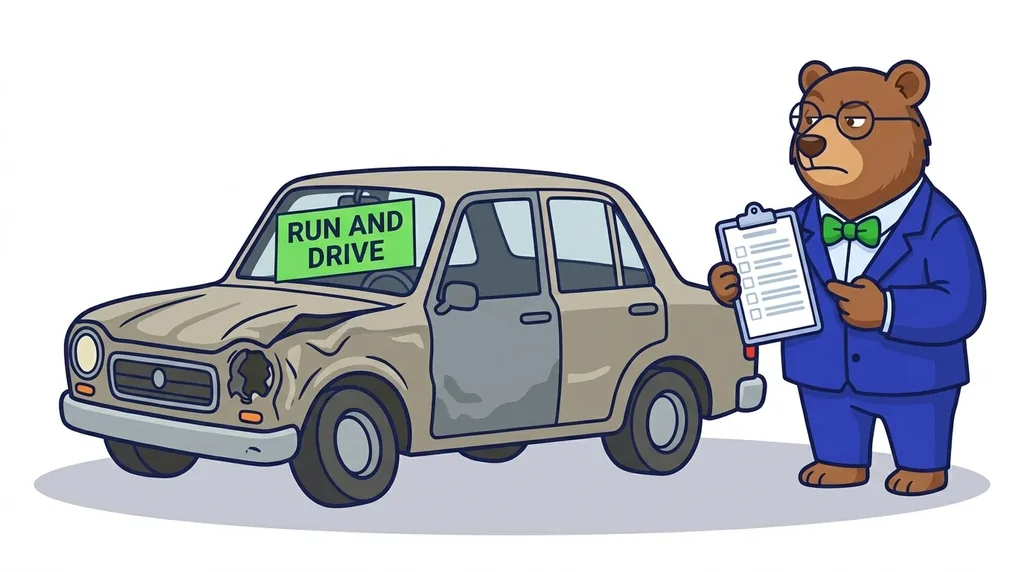
Run and Drive means it moved once, in a yard. It is not a statement about anything else.
Run and Drive means the vehicle started and moved under its own power at some point in the yard. It is not a statement about safety, legality, or whether the car will complete a journey, and a car can run and drive with serious faults. Budget as though transport may still be needed.
Clean title means the vehicle was never declared a total loss. That is weaker than it sounds. If damage was repaired privately, or without an insurance claim, nothing was declared and the title stays clean.
Salvage title means an insurer declared the car a total loss. Buyers treat it as a warning, and it is at least an honest one. Depending on local rules it can also make registration and resale considerably harder.
Sold as seen, and the protection you do have
At auction, the description is the contract.
Sold as seen means any fault, visible at the time or discovered later, becomes yours when the hammer falls. No warranty, no return, no renegotiation.
No major mechanical faults carries meaningfully more weight, and generally covers engine, gearbox, suspension, clutch, brakes and steering. It sets a higher expectation than a plain sold as seen listing.
You are not entirely without recourse. A materially misdescribed car, sold as running and arriving unable to start, usually gives grounds to challenge the sale, and if the auction house own condition report was inaccurate the claim may lie against the house rather than the seller. It is a narrow window and a poor substitute for checking first.
Why the listing is not enough
Everything on the auction sheet comes from the seller side. The damage codes are assigned in the yard. The title reflects only what was declared. The photographs were chosen by somebody who wants the car sold.
An independent history check is the only input that does not originate with the seller, and it covers what the auction sheet cannot: what happened to the car before it arrived.
It is also the only part of the record that survives what comes next. A car bought here gets repaired, exported, registered somewhere new and advertised as an ordinary used car, and at every one of those stages less of its past is visible. That is why the same check matters at both ends. Before you bid, it tells you what you are buying. Before you buy from a classified, it tells you whether the car in front of you came out of a yard like this one.
Panels get replaced and paperwork gets reissued. The history does not get repaired.
If you buy from a US auction
American salvage auctions carry more stock and often a lower hammer price, and Hungarian intermediaries offering the whole package exist. Two things change if you go that way.
First the arithmetic. A car from outside the EU pays customs duty and import VAT on arrival, and Hungary applies the highest standard VAT rate in the European Union. Add ocean freight, add a broker fee because most US lots require a dealer licence, and the cheaper hammer price is usually gone before the car reaches Hamburg.
Second the verification. A German car leaves a European paper trail you can check directly. An American car leaves an American one, and by the time it has passed through a broker, a shipping line and a repair shop, very little of it is visible from a Hungarian advert. The auction that photographed and coded its damage still holds that record. Nobody in the chain has a reason to hand it to you.
Your pre-buy checklist
- Run regado and illetek through a calculator before you commit.
- Confirm the car is EEA sourced, or budget duty and VAT on top.
- Check both parts of the German registration document exist.
- Match the VIN on the car to the VIN on every document.
- Run an independent history check before money moves.
- Ask whether the car was ever declared a total loss, and get it in writing.
- Check whether the foreign roadworthiness certificate is still valid.
- Look at panel gaps, boot floor and inner wings for repair evidence.
- Budget around 153,000 Ft in fees for a typical EEA car, more for a powerful one.
- Assume the originality check will take longer than you planned.
Hungary is importing more cars, faster, than at any time in seven years. The paperwork gets smoother every year. What the paperwork does not tell you has not changed at all.
Before you sign anything
Know what you are buying
Mileage, damage, finance and import records across 30+ countries, in one report, in under a minute.
- 30+ countries
- Under a minute
- Full PDF report
Not sure yet? See what a full report looks like first
Frequently asked questions
How much does it cost to import a car from Germany to Hungary?
For a typical EEA car, an 85 kW, five year old, 1598 cm3 example, the fees and taxes total about 153,460 Ft. That covers regado, homologation inspection, transfer duty, originality check, documents and plates. Regado and illetek scale with power, age and engine size, so a larger car costs considerably more.
Do I pay customs duty on a car from Germany?
No. Germany is in the EU, so there is no customs duty and no import VAT at the border. Those apply to cars bought outside the EU, such as at American auctions.
What is the eredetisegvizsga and why does it matter?
It is the originality check that verifies the vehicle identity and VIN before registration. It is also the step where discrepancies between the car and its documents tend to surface, which is why it is worth knowing what a history check says beforehand.
Is a German car automatically a safe buy?
No, but it is a checkable one. Germany supplies most of the region imports, which means its repaired accident cars and write offs enter those markets in proportion too. The advantage of a German car is that its history exists in a form you can verify.
About this guide
- Scope: this is the Hungary edition. The pan-European overview compares what registration adds in five markets, and the Germany edition covers the market almost all of this stock comes from.
- Import volumes: Hungarian registration statistics for imported used passenger cars, 2024 to 2026, covering cars given Hungarian plates for the first time.
- Fleet age: Hungarian passenger car fleet averages for 2025, with the split between company owned and privately owned vehicles.
- Costs: a published worked example for an 85 kW, five year old, 1598 cm3 car imported from the EEA with valid foreign roadworthiness. The transfer duty line matches the 2026 valorised rate of 750 Ft per kW for the four to eight year band. Regado and illetek vary with power, age and engine size, so treat the total as indicative rather than universal.
- Damage codes: described as the auctions publish them. They are assigned by hand, are reference only, and no purchase decision should rest on them alone.
Read next