
Buying a car at auction in Europe
One single market, one hammer price, and five completely different final bills. Where you register the car decides more of what it costs than what you bid for it.


Most European buyers never sit in a room like this. They bid through a broker, because the licence is not theirs.
The bidding is the same everywhere. Almost nothing after it is.
A car sold at a German salvage auction can be bought by a buyer in Warsaw, Budapest, Sofia or Lyon on the same terms, at the same moment, for the same money. What happens after the hammer falls is where the single market stops being simple. Registration taxes are national, they are not harmonised, and on the same car they range from a few hundred euro to more than the car is worth.
The short version
- Inside the EU there is no customs duty and no import VAT at a border.
- Outside it, expect roughly 10 percent duty plus your national VAT rate.
- Salvage auctions accept private buyers. Trade platforms do not.
- Registration cost varies enormously by country, and it is the number people forget.
- A CO2 based tax can exceed the price of the car in some markets.
Skip ahead: check a car nowcompare countries
Already watching a lot? The auction sheet tells you what the seller declared. A history check tells you what happened before the car reached the yard.
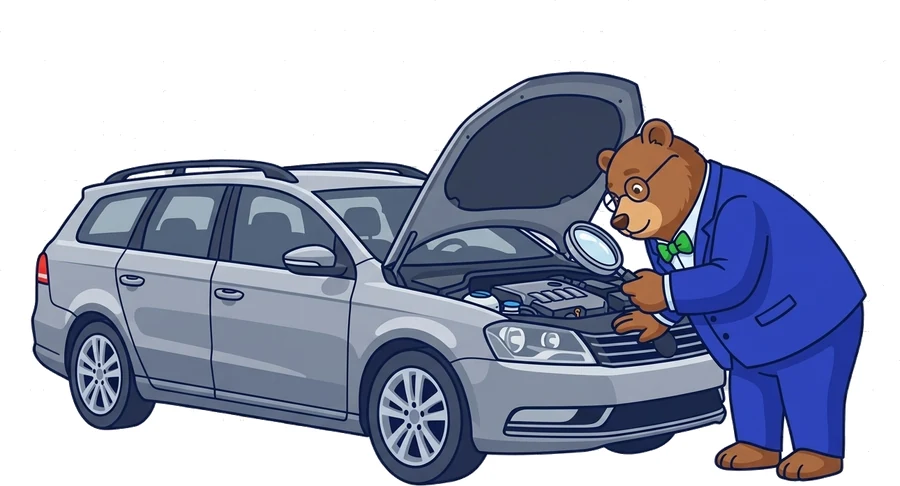
Check it before you bid
The auction sheet tells you what the seller declared. A history check tells you what happened before the car reached the yard.
Example: WBA3A5G59DNP26082Free preview included
- 30+ countries
- Result in under a minute
- Full PDF report
What the single market removes
The useful thing about buying inside the EU is what disappears. There is no customs duty, no import VAT collected at a border, and no ocean freight. A car moving from Germany to Hungary is a domestic purchase with a longer drive.
What does not disappear is national taxation on first registration. Every member state charges something, they are calculated on entirely different bases, and this is where the money is.
| Buying inside the EU | Buying outside the EU | |
|---|---|---|
| Customs duty | None | About 10% |
| Import VAT at the border | None | Your national rate, 19 to 27% |
| Freight | Road transport | Ocean freight, plus inland at both ends |
| Who can bid | Private buyers, on salvage platforms | Mostly dealer licence, so a broker fee |
| National registration tax | Yes, and it varies enormously | Yes, the same, on top of everything above |
That last row is the one that catches people. It applies either way, so a cheap hammer price in America does not escape it, it simply arrives after duty and VAT have already been added.
Who can actually bid
The belief that a private person cannot bid at a car auction is widespread and mostly wrong inside Europe. It comes from the American market, where most salvage lots genuinely do require a dealer licence.
| Platform type | Examples | Private buyers |
|---|---|---|
| EU salvage auctions | Copart Germany and its EU sites | Yes, register directly, no licence |
| Insurer residual value exchanges | National Restwert platforms | Usually trade only |
| Trade and fleet platforms | BCA, OPENLANE, Autorola | No, commercial status required |
| State and enforcement sales | National tax and bailiff portals | Yes, and often overlooked |
| US salvage auctions | Copart, IAAI | Only 5 to 10% of stock |
Copart operates in Germany and accepts registrations from private buyers in other EU countries, which is how a Polish or Hungarian buyer reaches German salvage stock without a broker. The catch is consistent across Europe: the auctions open to private buyers are the ones selling insurance write offs, while the platforms holding tidy ex lease cars with a full service history are the ones that want a trade licence. Easy access and clean cars are not the same thing.
The same car, seven countries
This is the part no national guide can show you. Take one car bought at one German auction, and follow what each market charges to put it on the road.
| Country | What registration adds | The line that decides it |
|---|---|---|
| Germany | Vollabnahme roughly 150 EUR to 300 EUR | Cheapest of the five for an EU car, because there is no registration tax |
| Hungary | About 153,000 Ft in fees and taxes | Regado and illetek are 63% of it and scale with power and age |
| Bulgaria | About 394 EUR to 793 EUR | Eco tax plus inspection, insurance and registration |
| Poland | About 1,100 to 4,000 zl | Homologation, if the car has no Certificate of Conformity |
| France | Carte grise, plus malus ecologique | The malus starts at 108 g/km and reaches 80,000 euro |
| Romania | About 740 lei at RAR, plus small fees | No registration tax at all, but no certificate of conformity means homologation |
| Latvia | About 60 EUR to 80 EUR | Cheapest to register, but the operating tax is annual and never stops |
Read the French row again. On a high emission car the environmental penalty alone can exceed what the car sold for, which makes France the only market in this group where the registration tax can be the largest single number in the transaction. A car that is a bargain in Warsaw can be unbuyable in Lyon, and the auction listing will not tell you which.
Germany sits at the opposite end. There is no registration tax on a normal EU purchase, which is part of why so much of the region stock is bought there and driven out.
The process, step by step
1. Confirm you can bid on that platform
Salvage platforms take private registrations. Trade platforms do not. Find out before you fall for a specific car.
2. Price the whole thing, in your country
Hammer price, buyer fee, transport, then your national registration tax. Work backwards from a total you are willing to spend to a maximum bid, and treat it as fixed.
3. Check the car, not the listing
Run the VIN before you bid. Everything in the listing comes from the seller side.
4. Bid, then pay fast
Auction payment clocks run in days. See the next section.
5. Move the car
Most salvage lots are unregistered and cannot be driven away. Budget a trailer, and remember free storage runs out quickly.
6. Register it at home
You will need the original registration documents, a purchase contract identifying the car by VIN, and usually a Certificate of Conformity. Missing the CoC is what turns a cheap import into an expensive one.
The deadlines that cost money
Auction houses run on short clocks, and the fees for missing them are not proportionate to the delay.
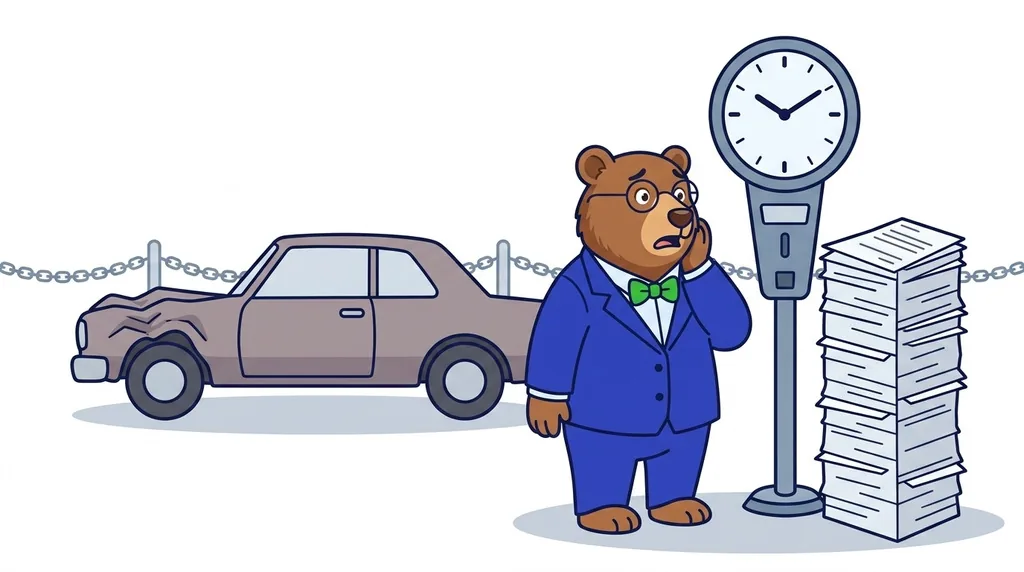
Storage is the quiet one. Five free days disappear while a trailer is still being arranged.
| What | Terms in Germany |
|---|---|
| Payment due | Immediately, with 3 working days including the invoice date |
| Late payment fee | 50 EUR |
| Free storage | 5 working days, including the auction day |
| Storage after that | 15 EUR per day |
| Getting the car out | Trailer or tow truck, red plates generally unavailable to private buyers |
Germany is more forgiving here than the American yards most import guides describe, where payment falls due in about two business days and storage runs at twenty to thirty dollars daily. Five free days and fifteen euro is a gentler clock. It is still a clock.
Damage codes, and what they actually mean
Listings carry short damage codes. They are useful and they are not reliable. They are assigned by people walking a yard, they are explicitly reference only, and they are frequently incomplete.
Impact and structural
FR front end
RR rear end
SD side
TP top or roof
FD frame damage reported
RO rollover
Panel damage is a repair job. Frame damage and rollover are a question about whether the car should be repaired at all.
Water, weather and external
WA water or flood
HL hail
VN vandalism
AO all over
Flood hides the most. Water works through wiring over months, so the car can drive perfectly on collection and fail progressively afterwards.
Fire and hazard
BN burn
BE burn, engine
BI burn, interior
BC biohazard or chemical
Mechanical and cosmetic
MC mechanical
NW normal wear
MN minor dents and scratches
MC is the least informative code in the set. It covers a flat battery and a destroyed gearbox equally.
Title and history flags
VI / VP missing or altered VIN
CC cash for clunkers
DH damage history
PR partial or incomplete repair
RJ rejected repair
ST stripped
PR and RJ deserve more attention than they get. Both mean somebody already tried to fix this car and stopped.
- High risk
- Medium
- Lower
| Risk | Codes | Why |
|---|---|---|
| High | FD, RO, WA, BN, BE, VI, VP | Structural, electrical or legal problems repair does not reliably solve |
| Medium | FR, RR, SD, TP, AO, MC, PR, RJ | Repairable, but cost varies enormously and the code will not say by how much |
| Lower | HL, VN, MN, NW, ST | Cosmetic or predictable, provided nothing else is listed alongside |
Never bid on a code alone. Check it against the photographs, the title status and an independent history report.
Words that mean less than they sound
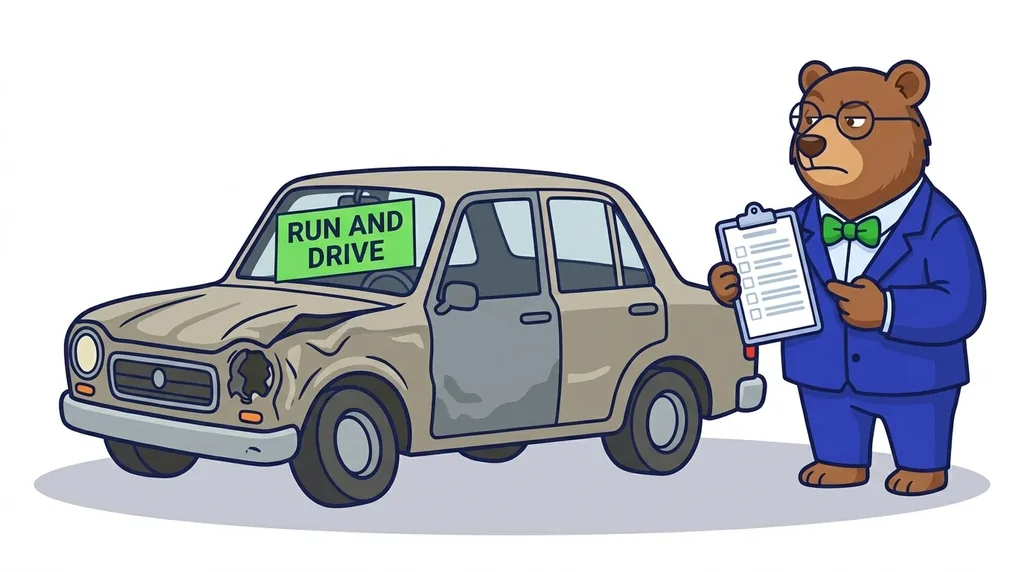
Run and Drive means it moved once, in a yard. It is not a statement about anything else.
Run and Drive means the vehicle started and moved under its own power at some point in the yard. It is not a statement about safety, legality, or whether the car will complete a journey, and a car can run and drive with serious faults. Budget as though transport may still be needed.
Clean title means the vehicle was never declared a total loss. That is weaker than it sounds. If damage was repaired privately, or without an insurance claim, nothing was declared and the title stays clean.
Salvage title means an insurer declared the car a total loss. Buyers treat it as a warning, and it is at least an honest one. Depending on local rules it can also make registration and resale considerably harder.
Sold as seen, and the protection you do have
At auction, the description is the contract.
Sold as seen means any fault, visible at the time or discovered later, becomes yours when the hammer falls. No warranty, no return, no renegotiation.
No major mechanical faults carries meaningfully more weight, and generally covers engine, gearbox, suspension, clutch, brakes and steering. It sets a higher expectation than a plain sold as seen listing.
You are not entirely without recourse. A materially misdescribed car, sold as running and arriving unable to start, usually gives grounds to challenge the sale, and if the auction house own condition report was inaccurate the claim may lie against the house rather than the seller. It is a narrow window and a poor substitute for checking first.
Why the listing is not enough
Everything on the auction sheet comes from the seller side. The damage codes are assigned in the yard. The title reflects only what was declared. The photographs were chosen by somebody who wants the car sold.
An independent history check is the only input that does not originate with the seller, and it covers what the auction sheet cannot: what happened to the car before it arrived.
It is also the only part of the record that survives what comes next. A car bought here gets repaired, exported, registered somewhere new and advertised as an ordinary used car, and at every one of those stages less of its past is visible. That is why the same check matters at both ends. Before you bid, it tells you what you are buying. Before you buy from a classified, it tells you whether the car in front of you came out of a yard like this one.
Panels get replaced and paperwork gets reissued. The history does not get repaired.
If you buy from a US auction
American salvage auctions carry far more stock and often a lower hammer price. Three things change when you leave the single market.
Duty and VAT. Roughly 10 percent customs duty on the CIF value, then your national VAT on top of that total. Since VAT is charged on a base that already includes the duty, the effective rate is higher than the two numbers suggest.
A broker. Most US lots require a dealer licence, so a broker fee of roughly 200 to 500 dollars and upward applies. Inside the EU you would not need one.
Verification. A European car leaves a European paper trail you can check. An American one leaves an American trail, and after a broker, a shipping line and possibly a repair shop, very little of it is visible from the advert you eventually see.
The national registration tax still applies on arrival, unchanged. It lands on a car that has already absorbed duty, VAT, freight and a broker fee.
Your pre-bid checklist
- Check whether the platform accepts private buyers before anything else.
- Calculate your national registration tax for that specific car.
- If it is a high emission car, check the CO2 penalty in your country first.
- Confirm whether a Certificate of Conformity exists.
- Set a total for the car delivered and registered, then work back to a maximum bid.
- Have cleared funds before bidding, not after winning.
- Read every damage code, and treat mechanical and partial repair as questions.
- Run an independent history check on the VIN.
- Budget transport, because most salvage lots cannot be driven away.
- Get a repair estimate from somebody who has seen the car, then add 20 percent.
The single market made the buying easy and left the taxing national. That gap is where most of the surprises live, and it is entirely knowable before you raise your hand.
Before you sign anything
Know what you are bidding on
Mileage, damage, finance and import records across 30+ countries, in one report, in under a minute.
- 30+ countries
- Under a minute
- Full PDF report
Not sure yet? See what a full report looks like first
Frequently asked questions
Do I pay customs duty on a car bought in another EU country?
No. There is no customs duty and no import VAT at a border inside the single market. You still pay whatever your own country charges to register the car, and that varies enormously.
Can a private person bid at a European car auction?
On salvage platforms, yes. Copart operates in Germany and accepts registrations from private buyers in other EU countries with no dealer licence. Trade platforms such as BCA, OPENLANE and Autorola require commercial status.
Which EU country is cheapest to register an imported car in?
Of the markets covered here, Germany, because a normal EU purchase carries no registration tax. France can be the most expensive by a wide margin, since the CO2 based malus starts at 108 g/km and reaches 80,000 euro on the highest emitting cars, although it is reduced by the car age and disappears entirely once the car is over about fifteen years old.
What is a Certificate of Conformity and do I need one?
It is the EU document confirming the car meets type approval standards. Registration is straightforward with it. Without it, some countries require individual homologation, which can cost thousands and take weeks.
About this guide
- Scope: this is the pan-European overview. Country specific figures, deadlines and registration steps are covered in the national editions: Germany, Poland, France, Hungary, Bulgaria, Romania and Latvia.
- Costs: national registration figures are typical ranges rather than quotes, and most of them scale with the specific vehicle. Calculate for your car before bidding.
- Damage codes: described as the auctions publish them. They are assigned by hand, are reference only, and no bidding decision should rest on them alone.
- Currency: amounts are quoted in the currency each market uses.
Read next