
Importing a used car to Romania
Romania registers more than two used cars for every new one, and charges almost nothing to put an imported car on the road. That makes it cheap, and it removes the filter every other market applies.


Most Romanian imports begin at a dealer or an auction somewhere further west.
Romania is one of the cheapest countries in the EU to register an imported car. That is the opportunity and the problem, in one sentence.
In the first half of 2026 Romania registered 171,276 used cars against 64,850 new ones. For every new car sold, more than two and a half used ones were put on the road, and a large share of them had just crossed a border. Almost nothing stands between an imported car and a Romanian number plate except paperwork.
The short version
- Romania has no registration tax and no pollution tax on an imported car.
- An EU car costs a few hundred lei in fees, not thousands.
- Missing the certificate of conformity replaces that with 1,500 to 6,000 lei of homologation.
- Germany is the single largest source, ahead of France and Italy.
- A cheap process is not a cheap car. The filter other markets apply with tax, Romania does not.
Skip ahead: check a car nowwhat it costs
Already looking at a specific car? The seller tells you what they know. A history check tells you what happened to the car before it reached the advert.
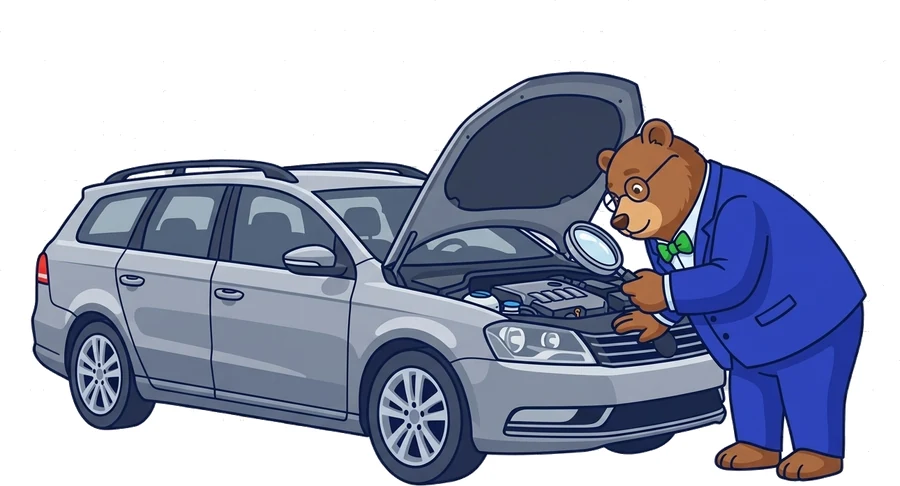
Check it before you bid
The auction sheet tells you what the seller declared. A history check tells you what happened before the car reached the yard.
Example: WBA3A5G59DNP26082Free preview included
- 30+ countries
- Result in under a minute
- Full PDF report
A market that runs on imports
Romania buys far more used cars than new ones, and a large part of the used market never had a Romanian first owner at all.
| Used cars registered, January to June 2026 | 171,276 |
| New cars registered, January to June 2026 | 64,850 |
| Used cars imported in January 2026 alone | about 26,000 |
That ratio is the whole story. A market where used registrations outnumber new ones almost three to one is a market where most transactions involve a car whose first years happened somewhere else, under somebody else, in a country whose records you cannot read from a Romanian advert.
Where the cars come from
Germany leads, as it does almost everywhere in the region, but Romania draws on a wider spread of countries than its neighbours do.
| Country of origin | Share of imported cars checked |
|---|---|
| Germany | 20.1% |
| France | 11.0% |
| Italy | 6.7% |
| Belgium | 5.9% |
| Netherlands | 4.0% |
Each of those countries writes cars off on its own terms and sells the wrecks at its own auctions. What arrives in Romania is the output of five different insurance markets, and the record of what was wrong with each car stays in the country that recorded it.
Our own figures put Romania among the countries where damage is most often recorded on the cars people ask us to check, and the pattern across the whole dataset is that two in five carry an accident on file.
The tax that is not there
Romania abolished the environmental stamp in 2017 and has not replaced it. There is no registration tax, no first registration levy and no CO2 penalty on bringing a car into the country.
Compare that with France, where a CO2 penalty can exceed the price of the vehicle, or Hungary, where registration tax and transfer duty together make up most of the bill. In Romania those lines simply do not exist. An EU car pays administrative fees and nothing else.
What registration actually costs
For a car bought inside the EU there is no customs duty and no import VAT at the border. What remains is a short list of administrative charges, and one of them can multiply if a document is missing.
| Charge | Typical amount |
|---|---|
| RAR check and vehicle identity card, standard EU car | 740 lei |
| Individual homologation, if there is no certificate of conformity | 1,500 lei to 6,000 lei instead |
| Registration certificate | 49 lei |
| Number plates | 52 lei |
| Technical inspection, cars over four years old | 100 lei to 160 lei |
| Registration tax or pollution tax | None. There is no such tax in Romania. |
The highlighted row is the one that catches people. A certificate of conformity turns registration into a formality. Without one, RAR has to homologate the car individually, and that single missing document can cost more than everything else in the table combined and add weeks to the timeline.
Ask for it before you pay, not after the car is on a trailer. A seller who cannot produce one for an ordinary European car is telling you something about the car.
The process, step by step
1. Check the car while it is still abroad
Everything after this step is paperwork. This is the only one that can still change your mind, and it costs a fraction of the cheapest line in the table above.
2. Get the certificate of conformity in the deal
Ask the seller for it in writing before you pay. Without it the RAR fee is replaced by individual homologation, which can cost eight times as much and add weeks.
3. Collect the original documents
For a German car that means both parts of the registration document, and a purchase contract that identifies the car by VIN. For any EU car you need the original registration papers, not a copy.
4. Technical inspection
Required for cars over four years old, and it has to be done within 30 days of submitting the registration file. Book it once the car is here, not before.
5. RAR, then the registration file
RAR issues the vehicle identity card. The registration file then goes to the vehicle registration service with the inspection, insurance and proof of ownership.
6. Insurance and plates
Compulsory insurance has to be in force before registration completes. Plates are issued at the end.
Damage codes, and what they actually mean
Listings carry short damage codes. They are useful and they are not reliable. They are assigned by people walking a yard, they are explicitly reference only, and they are frequently incomplete.
Impact and structural
FR front end
RR rear end
SD side
TP top or roof
FD frame damage reported
RO rollover
Panel damage is a repair job. Frame damage and rollover are a question about whether the car should be repaired at all.
Water, weather and external
WA water or flood
HL hail
VN vandalism
AO all over
Flood hides the most. Water works through wiring over months, so the car can drive perfectly on collection and fail progressively afterwards.
Fire and hazard
BN burn
BE burn, engine
BI burn, interior
BC biohazard or chemical
Mechanical and cosmetic
MC mechanical
NW normal wear
MN minor dents and scratches
MC is the least informative code in the set. It covers a flat battery and a destroyed gearbox equally.
Title and history flags
VI / VP missing or altered VIN
CC cash for clunkers
DH damage history
PR partial or incomplete repair
RJ rejected repair
ST stripped
PR and RJ deserve more attention than they get. Both mean somebody already tried to fix this car and stopped.
- High risk
- Medium
- Lower
| Risk | Codes | Why |
|---|---|---|
| High | FD, RO, WA, BN, BE, VI, VP | Structural, electrical or legal problems repair does not reliably solve |
| Medium | FR, RR, SD, TP, AO, MC, PR, RJ | Repairable, but cost varies enormously and the code will not say by how much |
| Lower | HL, VN, MN, NW, ST | Cosmetic or predictable, provided nothing else is listed alongside |
Never bid on a code alone. Check it against the photographs, the title status and an independent history report.
Words that mean less than they sound
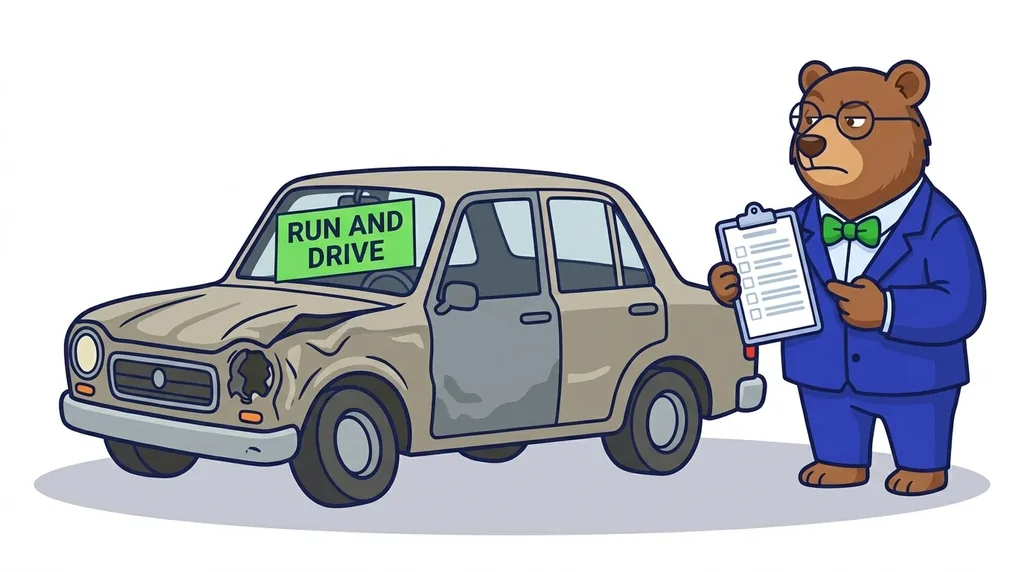
Run and Drive means it moved once, in a yard. It is not a statement about anything else.
Run and Drive means the vehicle started and moved under its own power at some point in the yard. It is not a statement about safety, legality, or whether the car will complete a journey, and a car can run and drive with serious faults. Budget as though transport may still be needed.
Clean title means the vehicle was never declared a total loss. That is weaker than it sounds. If damage was repaired privately, or without an insurance claim, nothing was declared and the title stays clean.
Salvage title means an insurer declared the car a total loss. Buyers treat it as a warning, and it is at least an honest one. Depending on local rules it can also make registration and resale considerably harder.
Sold as seen, and the protection you do have
At auction, the description is the contract.
Sold as seen means any fault, visible at the time or discovered later, becomes yours when the hammer falls. No warranty, no return, no renegotiation.
No major mechanical faults carries meaningfully more weight, and generally covers engine, gearbox, suspension, clutch, brakes and steering. It sets a higher expectation than a plain sold as seen listing.
You are not entirely without recourse. A materially misdescribed car, sold as running and arriving unable to start, usually gives grounds to challenge the sale, and if the auction house own condition report was inaccurate the claim may lie against the house rather than the seller. It is a narrow window and a poor substitute for checking first.
Why the listing is not enough
Everything on the auction sheet comes from the seller side. The damage codes are assigned in the yard. The title reflects only what was declared. The photographs were chosen by somebody who wants the car sold.
An independent history check is the only input that does not originate with the seller, and it covers what the auction sheet cannot: what happened to the car before it arrived.
It is also the only part of the record that survives what comes next. A car bought here gets repaired, exported, registered somewhere new and advertised as an ordinary used car, and at every one of those stages less of its past is visible. That is why the same check matters at both ends. Before you bid, it tells you what you are buying. Before you buy from a classified, it tells you whether the car in front of you came out of a yard like this one.
Panels get replaced and paperwork gets reissued. The history does not get repaired.
If you buy from outside the EU
Everything above assumes a car bought inside the single market. From outside it, two charges arrive before any of the Romanian fees: customs duty of roughly 10 percent, and import VAT at the Romanian rate on the total including that duty.
A car that was never built for the European market may also need individual certification, and a right hand drive car from outside the EU can no longer be registered without moving the driving position. That is not a fee, it is a rebuild.
Add ocean freight and a broker, because most American salvage lots require a dealer licence, and the cheaper hammer price is usually gone before the car reaches a European port. The verification problem is worse too: an American paper trail is harder to reach from a Romanian forecourt than a German one.
Your pre-buy checklist
- Confirm the certificate of conformity exists before you pay, in writing.
- Run an independent history check while the car is still abroad.
- Match the VIN on the car against the VIN on every document.
- For a German car, check both parts of the registration document are present.
- Ask whether the car was ever declared a total loss, and get it in writing.
- Budget the technical inspection if the car is over four years old.
- Look at panel gaps, boot floor and inner wings for repair evidence.
- If the car is from outside the EU, budget duty and VAT before anything else.
- Assume the inspection finds something on an older car.
- Get a repair estimate from somebody who has seen the car, then add 20 percent.
Romania made importing a car easy and left checking it entirely up to you. The paperwork is the cheap part. What the paperwork does not say is the expensive part.
Before you sign anything
Know what you are buying
Mileage, damage, finance and import records across 30+ countries, in one report, in under a minute.
- 30+ countries
- Under a minute
- Full PDF report
Not sure yet? See what a full report looks like first
Frequently asked questions
Is there a registration or pollution tax on an imported car in Romania?
No. Romania abolished the environmental stamp in 2017 and has not replaced it. An EU car pays administrative fees only, which is why Romania is one of the cheapest places in the union to put an imported car on the road, and part of why it absorbs so many of them.
What does it actually cost to register an imported car?
For a standard EU car with a certificate of conformity, budget around 740 lei at RAR including the vehicle identity card, 49 lei for the registration certificate, 52 lei for plates, and 100 to 160 lei for the technical inspection if the car is over four years old. Without a certificate of conformity, individual homologation replaces the RAR fee and runs 1,500 to 6,000 lei.
How long do I have to register the car?
The technical inspection has to be done no more than 30 days before you submit the registration file, so the inspection is what sets the clock rather than the purchase date. Cars under four years old are exempt from the inspection at first registration.
Does a cheap registration mean a cheap car?
It means a cheap process. Romania charges almost nothing to register an imported car, which removes a cost that other markets use as a filter. The cars that arrive here are frequently the ones a French or Danish buyer was priced out of, and the reason they were cheap elsewhere travels with them.
About this guide
- Scope: this is the Romania edition. The pan-European overview compares what registration adds across the region, and the Germany edition covers the market most of this stock comes from.
- Registration volumes: Romanian new and used passenger car registrations for January to June 2026, and monthly used import figures, from national registration reporting.
- Country of origin shares: distribution of imported vehicles checked in Romania during 2025. Shares are of imported cars checked, not of the whole car park.
- Fees: RAR tariffs, registration certificate and plate charges, and technical inspection ranges as published for 2026. Individual homologation varies widely with the vehicle, so treat the range as indicative and get a quote for your car.
- Damage codes: described as the auctions publish them. They are assigned by hand, are reference only, and no purchase decision should rest on them alone.
Read next