
Importing a used car to Latvia
Registration costs less than a tank of fuel and the deadline is thirty days. Almost half of what arrives comes from Germany, at seven to nine years old, which is exactly the age where the history stops being visible.


Close to half of every imported car in Latvia starts its second life in Germany.
Registering an imported car in Latvia costs less than a tank of fuel. Everything expensive about it happens before and after.
Close to half of every imported car in Latvia comes from Germany, roughly 20,000 of them in 2025, arriving at seven to nine years old and around 11,500 EUR. The registration itself is trivial. What decides whether the car was a good buy is settled long before it reaches CSDD.
The short version
- First registration costs 60 to 80 euro in total. There is no registration tax.
- The vehicle operating tax is annual and follows the car for as long as you own it.
- You have thirty days from bringing the car in to register it.
- Germany supplies about 45 percent of imports, at seven to nine years old.
- A car from outside the EU adds 10 percent duty and 21 percent VAT on top.
Skip ahead: check a car nowthe annual tax
Already looking at a specific car? The seller tells you what they know. A history check tells you what happened to the car before it reached the advert.
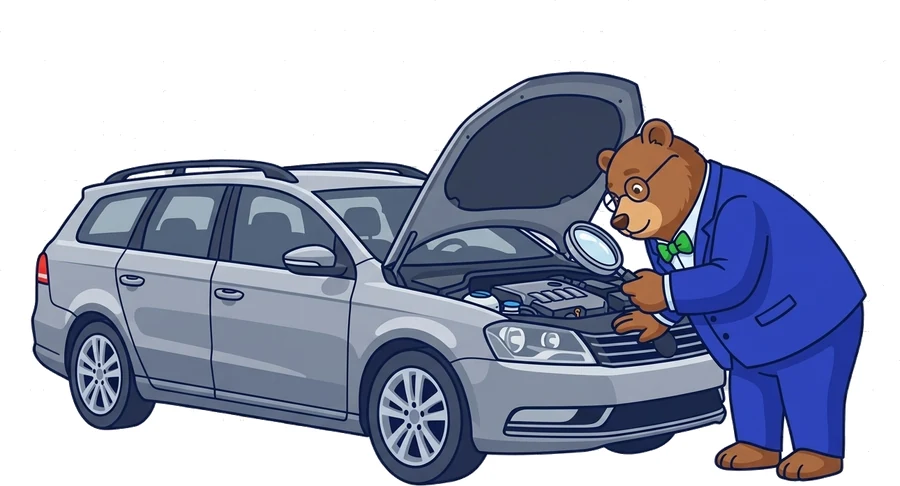
Check it before you bid
The auction sheet tells you what the seller declared. A history check tells you what happened before the car reached the yard.
Example: WBA3A5G59DNP26082Free preview included
- 30+ countries
- Result in under a minute
- Full PDF report
Where Latvian cars come from
Latvia is a small market that imports most of what it drives, and one country dominates the supply.
| Share of imported cars coming from Germany | 45% |
| Cars imported from Germany in 2025 | about 20,000 |
| Average age on arrival | 7 to 9 years |
| Average price of a German import | 11,500 EUR |
| Median price on the Latvian used market | 6,550 EUR |
Hold the last two rows against each other. The average German import arrives at about 11,500 EUR, while the median car actually on sale here is 6,550 EUR. The imports are the upper half of the market, which means the money at risk on a single bad decision is larger than the median suggests.
A car at seven to nine years old is exactly the age where its history stops being visible and starts being something you have to look up. It has had time for an accident and time for the odometer to be adjusted, and both are invisible on a clean forecourt.
Registration is the cheap part
Latvia charges almost nothing to put an imported car on the road. There is no registration tax and no CO2 penalty at the point of registration.
| Charge | Amount |
|---|---|
| State fee, first registration | 15 EUR |
| State fee if new plates are needed | 20 EUR |
| Roadworthiness test | 24 EUR to 45 EUR |
| Typical total for first registration | 60 EUR to 80 EUR |
| Vehicle operating tax | Separate, annual, and depends on the car |
| Individual certification, cars not built for the European market | Several hundred euro |
That total is small enough to disappear inside the rounding on a car purchase, which is precisely why it is worth saying out loud: registration is not where your money goes. The purchase, the annual tax and whatever the car needs to pass its test are the real numbers.
The tax that keeps coming back
The vehicle operating tax is the one people underestimate, because it is not a one off. It is charged every year the car is on the road, and how it is worked out depends on when the car was first registered.
Newer cars are taxed on CO2 emissions. Older ones are taxed on gross weight, engine capacity and power, with the highest of the three setting the rate. Rates rose in 2025 and stayed level for 2026. A few points on the scale, to give a sense of it:
| Basis | Operating tax |
|---|---|
| Gross weight 1501 to 1800 kg | 36 EUR per year |
| Engine 1501 to 2000 cm3 | 27 EUR per year |
| Power 56 to 92 kW | 27 EUR per year |
| Fully electric | Exempt |
These are points on a scale rather than the whole table, and the exact rate depends on the specific car, so run it through a calculator before you buy. The useful habit is to multiply it by the number of years you expect to keep the car, because that is the number that actually competes with the purchase price.
Thirty days, and why it matters
A car brought in from abroad has to be registered within thirty days. On paper that is generous. In practice the roadworthiness test sits inside that window, and on an imported car the test is where anything quietly repaired abroad tends to surface.
A failure at day twenty five leaves you finding a workshop, ordering a part and retesting against a deadline. That is an expensive way to discover something a check would have told you before the car was loaded.
The process, step by step
1. Check the car before it crosses a border
Once it is here you have thirty days and a test to pass. Everything you might have wanted to know should be known before the car is loaded.
2. Collect the original documents
For a German car that means both parts of the registration document and a purchase contract identifying the car by VIN. A missing second part is a serious problem, not an administrative one.
3. Work out the operating tax before you buy
It depends on the registration year and the technical data, and it is annual. A heavy older car and a light newer one can differ enough to matter over the years you keep it.
4. Roadworthiness test
Book it early. On an imported car it is where anything that was quietly repaired abroad tends to surface, and a failure inside a thirty day window is uncomfortable.
5. Insurance, then CSDD
Compulsory insurance has to be in place. Then the registration itself, which is the quickest and cheapest part of the whole exercise.
6. Pay the operating tax
Payable through e-CSDD or at a customer centre, and it recurs every year the car stays on the road.
Damage codes, and what they actually mean
Listings carry short damage codes. They are useful and they are not reliable. They are assigned by people walking a yard, they are explicitly reference only, and they are frequently incomplete.
Impact and structural
FR front end
RR rear end
SD side
TP top or roof
FD frame damage reported
RO rollover
Panel damage is a repair job. Frame damage and rollover are a question about whether the car should be repaired at all.
Water, weather and external
WA water or flood
HL hail
VN vandalism
AO all over
Flood hides the most. Water works through wiring over months, so the car can drive perfectly on collection and fail progressively afterwards.
Fire and hazard
BN burn
BE burn, engine
BI burn, interior
BC biohazard or chemical
Mechanical and cosmetic
MC mechanical
NW normal wear
MN minor dents and scratches
MC is the least informative code in the set. It covers a flat battery and a destroyed gearbox equally.
Title and history flags
VI / VP missing or altered VIN
CC cash for clunkers
DH damage history
PR partial or incomplete repair
RJ rejected repair
ST stripped
PR and RJ deserve more attention than they get. Both mean somebody already tried to fix this car and stopped.
- High risk
- Medium
- Lower
| Risk | Codes | Why |
|---|---|---|
| High | FD, RO, WA, BN, BE, VI, VP | Structural, electrical or legal problems repair does not reliably solve |
| Medium | FR, RR, SD, TP, AO, MC, PR, RJ | Repairable, but cost varies enormously and the code will not say by how much |
| Lower | HL, VN, MN, NW, ST | Cosmetic or predictable, provided nothing else is listed alongside |
Never bid on a code alone. Check it against the photographs, the title status and an independent history report.
Words that mean less than they sound
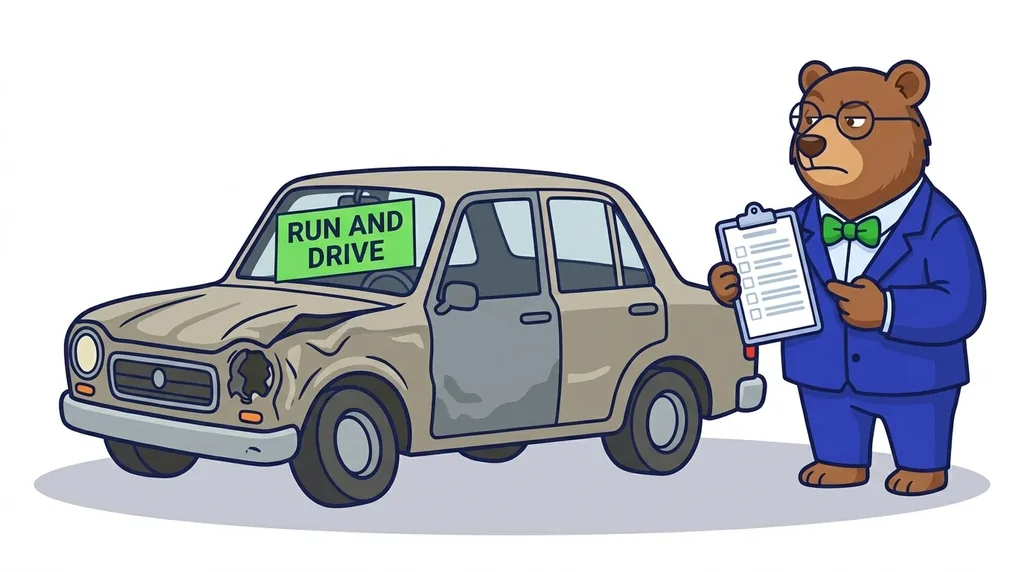
Run and Drive means it moved once, in a yard. It is not a statement about anything else.
Run and Drive means the vehicle started and moved under its own power at some point in the yard. It is not a statement about safety, legality, or whether the car will complete a journey, and a car can run and drive with serious faults. Budget as though transport may still be needed.
Clean title means the vehicle was never declared a total loss. That is weaker than it sounds. If damage was repaired privately, or without an insurance claim, nothing was declared and the title stays clean.
Salvage title means an insurer declared the car a total loss. Buyers treat it as a warning, and it is at least an honest one. Depending on local rules it can also make registration and resale considerably harder.
Sold as seen, and the protection you do have
At auction, the description is the contract.
Sold as seen means any fault, visible at the time or discovered later, becomes yours when the hammer falls. No warranty, no return, no renegotiation.
No major mechanical faults carries meaningfully more weight, and generally covers engine, gearbox, suspension, clutch, brakes and steering. It sets a higher expectation than a plain sold as seen listing.
You are not entirely without recourse. A materially misdescribed car, sold as running and arriving unable to start, usually gives grounds to challenge the sale, and if the auction house own condition report was inaccurate the claim may lie against the house rather than the seller. It is a narrow window and a poor substitute for checking first.
Why the listing is not enough
Everything on the auction sheet comes from the seller side. The damage codes are assigned in the yard. The title reflects only what was declared. The photographs were chosen by somebody who wants the car sold.
An independent history check is the only input that does not originate with the seller, and it covers what the auction sheet cannot: what happened to the car before it arrived.
It is also the only part of the record that survives what comes next. A car bought here gets repaired, exported, registered somewhere new and advertised as an ordinary used car, and at every one of those stages less of its past is visible. That is why the same check matters at both ends. Before you bid, it tells you what you are buying. Before you buy from a classified, it tells you whether the car in front of you came out of a yard like this one.
Panels get replaced and paperwork gets reissued. The history does not get repaired.
If you buy from outside the EU
Everything above assumes a car bought inside the single market. From outside it, customs duty of about 10 percent and VAT at 21 percent arrive before any Latvian fee, and VAT is charged on a base that already includes the duty.
A car that was not built for the European market also needs individual certification, which runs to several hundred euro and is not always possible. Add ocean freight and a broker, because most American salvage lots require a dealer licence.
The verification problem is the quieter one. A German car leaves a European paper trail you can reach. An American car leaves an American one, and after a broker, a shipping line and a workshop, very little of it is visible from a Latvian advert.
Your pre-buy checklist
- Run an independent history check before the car leaves the seller country.
- Calculate the annual operating tax for that specific car, not a similar one.
- Check both parts of the German registration document exist.
- Match the VIN on the car against the VIN on every document.
- Ask whether the car was ever declared a total loss, and get it in writing.
- Compare the odometer against the recorded history, not against the condition.
- Plan the roadworthiness test inside the thirty day window, not at the end of it.
- Look at panel gaps, boot floor and inner wings for repair evidence.
- If the car is from outside the EU, budget duty and VAT before anything else.
- Get a repair estimate from somebody who has seen the car, then add 20 percent.
Latvia made the registration cheap and the deadline short. That combination rewards people who did their checking early and punishes everyone else on a thirty day clock.
Before you sign anything
Know what you are buying
Mileage, damage, finance and import records across 30+ countries, in one report, in under a minute.
- 30+ countries
- Under a minute
- Full PDF report
Not sure yet? See what a full report looks like first
Frequently asked questions
What does it cost to register an imported car at CSDD?
The state fee for first registration is 15 euro, or 20 euro if you need new plates, and the roadworthiness test runs 24 to 45 euro depending on category. Most people land between 60 and 80 euro all in. That is the registration itself, not the vehicle operating tax, which is separate and annual.
How long do I have to register a car brought in from abroad?
Thirty days from bringing it in. That is a real deadline rather than a guideline, and it is short enough that the roadworthiness test and any repair needed to pass it have to be planned before the car arrives, not after.
How is the vehicle operating tax calculated?
It depends on when the car was first registered. Newer cars are taxed on CO2 emissions, older ones on gross weight, engine capacity and power, with the highest of those three deciding the rate. Fully electric cars are exempt. Unlike a registration tax it is annual, so it follows the car for as long as you own it.
Is a German car a safer buy than a local one?
It is a more checkable one. Germany supplies close to half of Latvian imports, and German records are unusually complete, which means a German car can be verified in a way many others cannot. That is different from being undamaged, and the difference is the whole reason to run the check.
About this guide
- Scope: this is the Latvia edition. The pan-European overview compares what registration adds across the region, and the Germany edition covers the market almost half of these cars come from.
- Market figures: Latvian import shares, volumes, arrival age and prices for 2025, with median asking price from 2026 market reporting. Averages describe the import flow, not the whole car park.
- Registration fees: CSDD state fees for first registration and roadworthiness test ranges as published for 2026. The thirty day deadline applies from bringing the vehicle into the country.
- Operating tax: the rates shown are individual points on the scale, chosen to illustrate the two calculation methods, and are not the full table. Rates rose in 2025 and are unchanged for 2026. Calculate for the specific vehicle before relying on any figure here.
- Damage codes: described as the auctions publish them. They are assigned by hand, are reference only, and no purchase decision should rest on them alone.
Read next