
How to buy a car on mobile.de and bring it to Romania
Romania registers more than two used cars for every new one and charges almost nothing to put an imported one on the road. That makes mobile.de the obvious place to shop, and it removes the filter every other market applies.

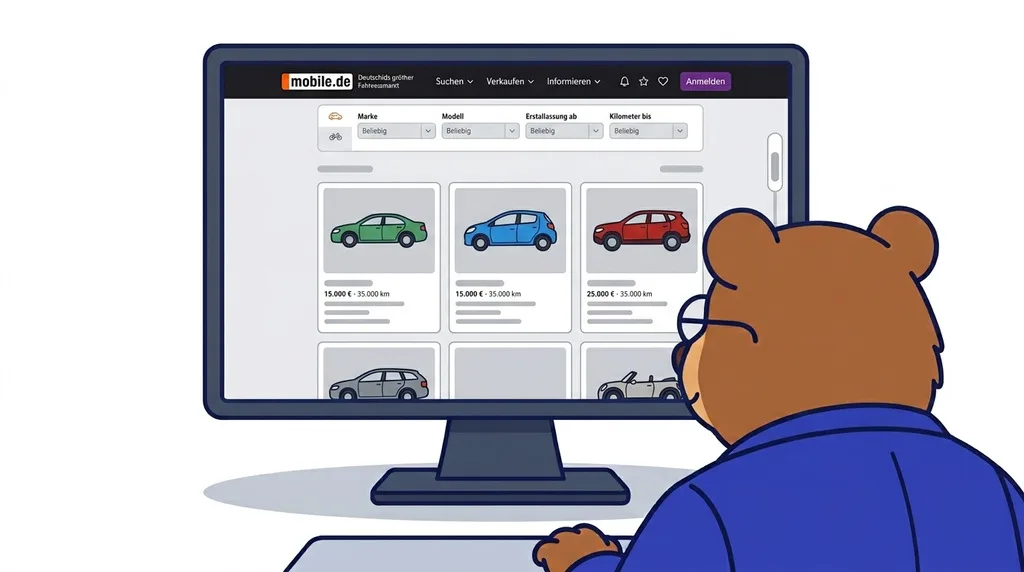
Finding the right listing is the hard part. Everything after it is negotiation.
The short version
- 47 percent of buyers get no discount at all. The biggest saving is asking.
- 5 to 10 percent is normal at a dealer, up to 15 when the car has been sitting.
- A written repair quote beats any argument. Defects are the strongest lever.
- A German dealer owes you a year of statutory warranty. A private seller owes nothing.
- Collecting it costs 205 EUR to 370 EUR per 1,000 km, plus about 150 EUR for export plates.
- No duty, no import VAT and no registration tax at all. A standard EU car costs a few hundred lei in fees.
Skip ahead: check a car nowwhat Romania charges
Already found the car? The listing tells you what the seller declared. A history check tells you what actually happened before you get there.

Check it before you travel
The listing tells you what the seller declared. A history check tells you what actually happened before you get there.
Example: WBA3A5G59DNP26082Free preview included
- 30+ countries
- Result in under a minute
- Full PDF report
Know the number before you speak
Most negotiations are decided before they even begin.
If you do not know what the car is worth, you are negotiating from a weak position. mobile.de can estimate a vehicle value in a couple of minutes and show enough comparable listings to reveal the price range it should sit within.
Run the valuation on the exact specification and write the figure down. Treat it as a range rather than a final answer. The tool cannot see the condition of the specific car in front of you, and condition is exactly what you will be negotiating over.
Where the discount actually comes from
A survey of around one thousand German car buyers found that 47 percent received no discount at all. Among those who did negotiate successfully, the average was 5.7 percent, roughly 915 EUR on a car priced at 18,310 EUR.
Expect 5 to 10 percent at a dealer, and up to 15 percent when conditions are favourable.
| Lever | What it is worth |
|---|---|
| A written repair quote | The exact amount. Dealers rarely argue with a garage estimate |
| Timing belt due | 400 EUR to 900 EUR |
| Tyres worn | 400 EUR to 800 EUR for a replacement set |
| Long time on the market | Pushes you toward the upper end of the range |
| End of month or quarter | Flexibility that does not exist mid-month |
| Season | Spring is cheapest, winter dearest |
A repair quote is the strongest of these by a distance. Arrive with a mechanic estimate and deduct it, and you are not haggling, you are correcting a price.
If the price will not move, move something else
German dealers are more willing to include extras than to reduce the advertised price, because the headline figure is what many dealerships are measured on.
Ask for a free service, winter tyres, an extended warranty or a service package. Each can be worth several hundred euro to you while costing the dealer less than an equivalent cash discount, which is exactly why they agree to it more readily.
Asking for an extra after a discount has been refused works far more often than asking for the discount twice.
Dealer or private, and why it is not only about price
| Dealer | Private seller | |
|---|---|---|
| Price | Higher | Lower |
| Statutory warranty | One year minimum, by law | None |
| Recourse if something fails | Real | Very limited |
| Room to negotiate | 5 to 15 percent | Usually less |
A German dealer sale includes Gewaehrleistung, a statutory liability period of at least one year that cannot simply be removed from the contract. A private seller provides no such protection.
That legal protection is part of what the higher price pays for, which is why the cheapest listing is not automatically the best value. Note the distinction: Gewaehrleistung is required by law, while Garantie is an optional product sold on top, and that one is negotiable.
Reading a German listing
| Term | What it means |
|---|---|
| Unfallfrei | No accident history claimed. A claim, not a guarantee |
| Unfallfahrzeug | Accident vehicle, priced accordingly |
| Nach Unfall instandgesetzt | Repaired after an accident. Ask who repaired it and to what standard |
| HU neu | Fresh roadworthiness inspection. Worth real money |
| HU abgelaufen | Expired. Budget for the test and any repairs it uncovers |
| Scheckheftgepflegt | Full service history. Ask for the book, not the word |
| Bastlerfahrzeug | Project car. Assume repairs are needed |
HU is the German roadworthiness inspection. A car with a recent HU has just been examined by an independent engineer with no incentive to overlook problems, which makes it the closest thing to a free third-party inspection on the platform.
What to filter for when nothing is taxed
Romania abolished the environmental stamp in 2017 and has not replaced it. There is no registration tax, no first registration levy and no CO2 penalty. That removes the thing every other market on this page spends its filters dodging, and it changes what the filters are for.
| Filter | Set it to | Why |
|---|---|---|
| Certificate of Conformity | Ask before you pay | Without it the RAR fee is replaced by homologation at 1,500 to 6,000 lei |
| HU, roadworthiness | Valid, not expired | A car with fresh German roadworthiness walks through the Romanian inspection |
| Scheckheftgepflegt, service history | Filter for it | With no registration tax, the car itself is the only filter left |
A registration tax is a filter. It prices out the oldest, dirtiest and most damaged cars before they ever reach the country. Romania has taken that filter away, which makes importing cheap and makes checking the car the only filter left standing.

Ask for a live video call. Most of it ends right here.
The scams, and how they find you
Most fraud targets buyers who cannot easily inspect the vehicle in person, which means foreign buyers are the preferred target.
Fortunately, most scams fall apart the moment you request a live video call showing the VIN plate, the dashboard and a cold start.
| Signal | What it usually means |
|---|---|
| Far below a tight cluster of comparable listings | Something is undisclosed, or the car does not exist |
| Refuses a live video call | No car, or not the car being advertised |
| Wants to move immediately to WhatsApp | No paper trail wanted |
| Deposit before viewing | Fraud |
| Payment through a personal account, crypto or gift cards | Fraud |
| Offers their own shipping or escrow service | Fraud. Genuine escrow is arranged by the buyer |
| Documents only shown as photographs | The documents may belong to another vehicle |
The moment you buy the car, it is uninsured, registered to somebody else, and not legally ready for you to drive away.
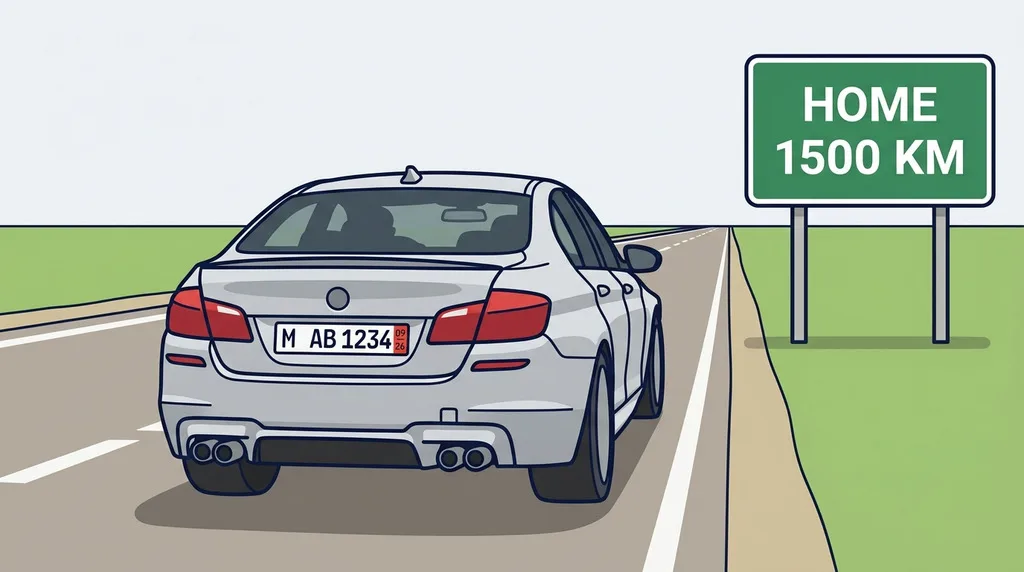
Export plates carry a red band on the right, showing the date they expire.
Export plates, and the mistake that voids your insurance
Most countries offer some form of temporary registration for moving an unregistered vehicle. The distinction that matters is simple.
| Type | Purpose | Crosses a border |
|---|---|---|
| Short-term or trade plates | Movement within the issuing country | No |
| Export plates | Permanent export from the country | Yes |
This is one of the most common mistakes buyers make. Short-term plates are cheaper, easy to obtain, and the registration office will happily sell them to you. Both the plates and the insurance behind them become invalid the moment you leave the issuing country. If you are taking the vehicle abroad, say that you are exporting it.
German export plates, Ausfuhrkennzeichen, are white with a red expiry section, and the insurance behind them remains valid across Europe for the full validity period, which you choose when you buy them.
| Item | Typical cost |
|---|---|
| Plates | around 95 EUR |
| Registration office fee | around 30 EUR |
| Vehicle tax for the validity period | around 15 EUR |
| Total | around 150 EUR |
You will need both parts of the vehicle registration documents, identification, proof of address, valid HU, and an eVB number, the electronic insurance confirmation. Obtaining one takes a few minutes online, and no office will issue export plates without it. It is the requirement people forget.
If the vehicle is not roadworthy, export plates are irrelevant and you need transport instead.
What it actually costs to collect
The collection trip is a real expense and most buyers underestimate it. Some costs are fixed regardless of distance, others rise with every kilometre.
Fixed: flight or train to Germany, 80 EUR to 200 EUR, plus export plates and insurance at around 150 EUR.
Per 1,000 km driven home: fuel 105 EUR to 140 EUR at 6 to 8 l/100 km, tolls 0 EUR to 50 EUR, food 40 EUR to 60 EUR, and one hotel night 60 EUR to 120 EUR. That comes to roughly 205 EUR to 370 EUR per 1,000 km.
| One-way distance | Driving it home | Transporter |
|---|---|---|
| 500 km | 300 EUR to 495 EUR | 300 EUR to 650 EUR |
| 1,000 km | 410 EUR to 710 EUR | 450 EUR to 900 EUR |
| 1,500 km | 550 EUR to 965 EUR | 600 EUR to 1,200 EUR |
| 2,000 km | 625 EUR to 1,100 EUR | 700 EUR to 1,400 EUR |
Transport costs run from about 0.72 to 1.30 euro per kilometre on shorter routes, with the rate per kilometre falling as the distance grows. Under roughly 600 km the hotel stop disappears.
The difference between the two columns is smaller than most people expect, so the choice is about risk rather than money.
Drive it yourself if the listing is the first time you have seen the car. You get to start it, test it and put the first kilometres on it while the seller is still nearby.
Transport it if you have already inspected the vehicle, trust the dealer, or the car cannot be driven.
What Romania charges
A German car is an intra-EU purchase, so there is no customs duty and no import VAT at the border. Romania then adds no registration tax on top of that, which makes it one of the cheapest countries in the EU to put an imported car on the road.
| Charge | Typical amount |
|---|---|
| RAR check and vehicle identity card, standard EU car | 740 lei |
| Individual homologation, if there is no certificate of conformity | 1,500 lei to 6,000 lei instead |
| Registration certificate | 49 lei |
| Number plates | 52 lei |
| Technical inspection, cars over four years old | 100 lei to 160 lei |
| Registration tax or pollution tax | None. There is no such tax in Romania. |
Read the highlighted row against the one above it. With the certificate of conformity, the RAR side of the file is 740 lei. Without it, the same step becomes 1,500 lei to 6,000 lei and adds two to six weeks. It is the one line in this table that can move by a factor of eight, and it is decided by a question you can ask the seller for free.
Everything else is small and fixed. A standard EU car with its papers in order costs a few hundred lei in fees, not thousands, and the technical inspection only applies once the car is over four years old.
That is the opportunity and the problem in one sentence. A cheap process is not a cheap car. Romania registers more than two used cars for every new one, and nothing between the German listing and Romanian plates asks what happened to this one.
What goes wrong on the way home
The export plate expires before you arrive. You choose the validity period when you buy it. Choose longer than you think you will need.
The insurance does not cover your route. Policies name specific countries. Check every one you will pass through, especially if the route leaves EU territory.
You are too tired to drive safely. A long flight followed by hours in an unfamiliar vehicle is the most dangerous part of the entire purchase. Budget for a hotel.
Before you hand over money
- Establish the market value of the exact specification.
- Obtain the VIN in writing and run a history check.
- Request a video call showing the VIN plate, dashboard and a cold start.
- Confirm the HU status and date, and get repair estimates for visible issues.
- Verify in person that the VIN matches every document.
- Confirm both parts of the vehicle registration papers are present.
- Confirm a Certificate of Conformity exists, or price the homologation.
- Calculate registration costs at home for that exact vehicle.
- Arrange eVB insurance and export plates before travelling.
- Decide your maximum price, and keep every German document afterwards.
The advertised price is the number everybody argues about. Every other number in this article is where the rest of the money goes.
Before you sign anything
Know what you are buying
Mileage, damage, finance and import records across 30+ countries, in one report, in under a minute.
- 30+ countries
- Under a minute
- Full PDF report
Not sure yet? See what a full report looks like first
Frequently asked questions
Is there customs duty or import VAT on a car bought in Germany?
No. A German car is an intra-EU purchase, so there is no customs duty and no import VAT at the border. Romania also has no registration tax and no pollution tax, so what remains is a few hundred lei of fees.
What does it cost to register an imported car in Romania?
The RAR check and vehicle identity card are 740 lei, the registration certificate 49 lei and the plates 52 lei. A technical inspection on a car over four years old adds 100 to 160 lei. That is the whole bill for a standard EU car with its papers in order.
What happens if the car has no certificate of conformity?
The 740 lei RAR fee is replaced by individual homologation at 1,500 to 6,000 lei, and it adds weeks. It is the single largest swing in the whole process, so ask the seller for the certificate in writing before you pay, not after.
If registration is this cheap, what is the catch?
A registration tax is a filter: it prices the oldest and most damaged cars out before they reach the country. Romania removed that filter in 2017 and has not replaced it. Nothing between the German listing and Romanian plates asks what happened to the car, which leaves the history check as the only filter there is.
About this guide
- Scope: this is the Romania edition. The pan-European edition covers what registration costs elsewhere, and the Germany edition covers the market these cars come from.
- Registration costs: RAR, registration certificate, plate and inspection fees as published for a standard EU car. The homologation range applies only where no certificate of conformity exists. Romania abolished the environmental stamp in 2017 and has not introduced a replacement.
- Discount figures: from a survey of approximately one thousand German car buyers. The 5.7 percent average is across buyers who negotiated successfully, not across all buyers.
- Plate and travel costs: typical estimates rather than fixed prices. They vary by vehicle, route, insurer and registration office, and are worth confirming for the specific car before you budget from them.
- Listing terms: the German words are left as they appear on the platform, because a translated term cannot be searched for. Unfallfrei in particular is a seller declaration, not a verified fact.
- Why the VIN matters here: a border crossing is where a car paper trail usually goes missing, covered in how to check an imported car, and the mileage side in odometer fraud.
Read next