
How to buy a car on mobile.de and pay the right price
mobile.de carries more used cars than anywhere else in the German speaking world, which makes it the best place to buy one and the easiest place to overpay. Roughly half of all buyers negotiate nothing at all.

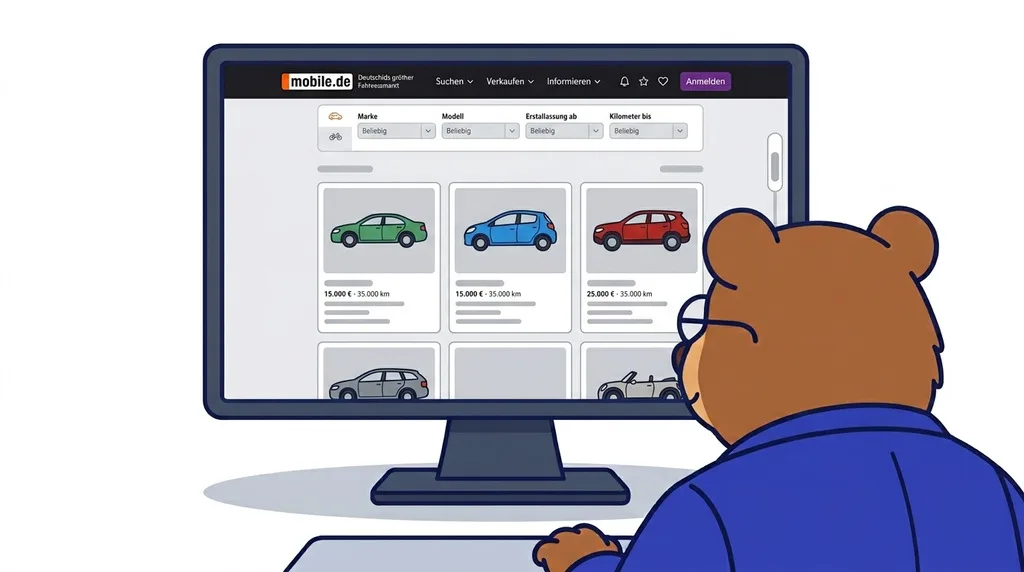
Finding the right listing is the hard part. Everything after it is negotiation.
The buyers who negotiate save an average of 5.7 percent, which is 915 EUR on a car priced at 18,310 EUR, for a conversation that lasts ten minutes.
The short version
- 47 percent of buyers get no discount at all. The biggest saving is asking.
- 5 to 10 percent is normal at a dealer, up to 15 when the car has been sitting.
- A written repair quote beats any argument. Defects are the strongest lever.
- A dealer owes you a year of Gewaehrleistung. A private seller owes nothing.
- Set up a saved search. The genuinely good listings are gone within a day.
Skip ahead: check a car nowwhere the discount comes from
Already found the car? The listing tells you what the seller declared. A history check tells you what actually happened to it.

Check it before you drive over
The listing tells you what the seller declared. A history check tells you what actually happened to the car.
Example: WBA3A5G59DNP26082Free preview included
- 30+ countries
- Result in under a minute
- Full PDF report
Getting there first
Most advice about buying well assumes you already found the car. On mobile.de the finding is the hard part, because a correctly priced car with a full service history does not sit around waiting to be negotiated over.
Set up a saved search with alerts on the exact specification, then widen it in three directions people usually forget.
| Widen | Why |
|---|---|
| Radius | Two hours further out is a different local market, often several hundred euro cheaper |
| Colour and trim | Filtering hard on both cuts your results to almost nothing |
| Dealer and private together | Most buyers filter one out and halve their own choice |
Then sort by newest listing rather than by price. Sorting by price shows you what everyone else is already looking at.
The mirror image is Standzeit, how long a car has been listed. A fresh listing is competition. A listing that has been up for weeks is leverage, because the dealer is paying to keep it there and knows the market has already seen it.
Know the number before you speak
Most negotiations are decided before they even begin.
If you do not know what the car is worth, you are negotiating from a weak position. mobile.de can estimate a vehicle value in a couple of minutes and show enough comparable listings to reveal the price range it should sit within.
Run the valuation on the exact specification and write the figure down. Treat it as a range rather than a final answer. The tool cannot see the condition of the specific car in front of you, and condition is exactly what you will be negotiating over.
Where the discount actually comes from
A survey of around one thousand German car buyers found that 47 percent received no discount at all. Among those who did negotiate successfully, the average was 5.7 percent, roughly 915 EUR on a car priced at 18,310 EUR.
Expect 5 to 10 percent at a dealer, and up to 15 percent when conditions are favourable.
| Lever | What it is worth |
|---|---|
| A written repair quote | The exact amount. Dealers rarely argue with a garage estimate |
| Timing belt due | 400 EUR to 900 EUR |
| Tyres worn | 400 EUR to 800 EUR for a replacement set |
| Long time on the market | Pushes you toward the upper end of the range |
| End of month or quarter | Flexibility that does not exist mid-month |
| Season | Spring is cheapest, winter dearest |
A repair quote is the strongest of these by a distance. Arrive with a mechanic estimate and deduct it, and you are not haggling, you are correcting a price.
If the price will not move, move something else
German dealers are more willing to include extras than to reduce the advertised price, because the headline figure is what many dealerships are measured on.
Ask for a free service, winter tyres, an extended warranty or a service package. Each can be worth several hundred euro to you while costing the dealer less than an equivalent cash discount, which is exactly why they agree to it more readily.
Asking for an extra after a discount has been refused works far more often than asking for the discount twice.
Dealer or private, and why it is not only about price
| Dealer | Private seller | |
|---|---|---|
| Price | Higher | Lower |
| Statutory warranty | One year minimum, by law | None |
| Recourse if something fails | Real | Very limited |
| Room to negotiate | 5 to 15 percent | Usually less |
A German dealer sale includes Gewaehrleistung, a statutory liability period of at least one year that cannot simply be removed from the contract. A private seller provides no such protection.
That legal protection is part of what the higher price pays for, which is why the cheapest listing is not automatically the best value. Note the distinction: Gewaehrleistung is required by law, while Garantie is an optional product sold on top, and that one is negotiable.
Reading a German listing
| Term | What it means |
|---|---|
| Unfallfrei | No accident history claimed. A claim, not a guarantee |
| Unfallfahrzeug | Accident vehicle, priced accordingly |
| Nach Unfall instandgesetzt | Repaired after an accident. Ask who repaired it and to what standard |
| HU neu | Fresh roadworthiness inspection. Worth real money |
| HU abgelaufen | Expired. Budget for the test and any repairs it uncovers |
| Scheckheftgepflegt | Full service history. Ask for the book, not the word |
| Bastlerfahrzeug | Project car. Assume repairs are needed |
HU is the German roadworthiness inspection. A car with a recent HU has just been examined by an independent engineer with no incentive to overlook problems, which makes it the closest thing to a free third-party inspection on the platform.

Ask for a live video call. Most of it ends right here.
The listings to walk away from
Fraud here is aimed mostly at buyers who cannot easily visit, so it is less common when you can drive over the same afternoon. It still exists.
| Signal | What it usually means |
|---|---|
| Far under a tight cluster of comparables | Something undisclosed, or no car |
| Seller is abroad and the car is in storage | No car |
| Wants to move to WhatsApp immediately | No paper trail wanted |
| Deposit before viewing | Theft |
| Payment to a personal account, crypto or gift cards | Theft |
| Documents only ever shown as photographs | Documents belong to another car |
None of it survives one request: a live video call showing the VIN plate, the dashboard and a cold start. A seller with a real car has no reason to refuse.
What it costs after the handshake
Buying inside Germany means no import, no duty and no customs paperwork. What remains is small, but it is not nothing.
| Item | Typical cost |
|---|---|
| Ummeldung, re-registration | about 30 EUR to 60 EUR |
| New plates | about 20 EUR to 40 EUR |
| eVB insurance confirmation | free, arranged online in minutes |
| Kurzzeitkennzeichen, to drive it home unregistered | about 65 EUR to 120 EUR |
Short-term plates are valid for up to five days and only inside Germany. If the car is still registered to the seller when you drive it away, agree how their plates come off and go back before the money moves, not after.
Two ongoing costs are worth checking before you buy, because they attach to the car rather than to you.
Kfz-Steuer, the annual vehicle tax, is calculated from engine size and CO2, and two versions of the same model can differ noticeably.
Typklasse and Regionalklasse set your insurance premium from the model and your postcode. A cheap car in a bad insurance class can cost more per year than a dearer one in a good class.
Before you hand over money
- Establish the market value for that exact specification.
- Get the VIN in writing and run a history check against it.
- Confirm HU status and date, and get a repair quote for anything visible.
- Check the VIN on the car matches the documents, in person.
- Confirm both parts of the Zulassungsbescheinigung are present.
- Check the service book exists rather than trusting the word Scheckheftgepflegt.
- Look up Kfz-Steuer and the insurance class for this exact version.
- Agree what happens to the seller plates before you pay.
- Arrange eVB cover so you can register without waiting.
- Decide your walk-away number and keep to it.
The advertised price is the number everybody argues about. The service book, the HU date and the insurance class decide what the car actually costs to own.
Before you sign anything
Know what you are buying
Mileage, damage, finance and import records across 30+ countries, in one report, in under a minute.
- 30+ countries
- Under a minute
- Full PDF report
Not sure yet? See what a full report looks like first
Frequently asked questions
How much discount is realistic on mobile.de?
5 to 10 percent at a dealer, and up to 15 percent on a car that has been listed for weeks. In a survey of around a thousand German buyers the average successful discount was 5.7 percent, while 47 percent got nothing, mostly because they never asked.
What is the difference between Gewaehrleistung and Garantie?
Gewaehrleistung is statutory. A dealer owes it for at least one year and it cannot simply be written out of the contract. Garantie is an optional product sold on top, and unlike the statutory period it is negotiable.
What does it cost to re-register the car after buying it?
Around 30 to 60 EUR for the Ummeldung and 20 to 40 EUR for plates. The eVB insurance confirmation is free and takes minutes online. Short-term plates, if you need to drive the car home unregistered, run about 65 to 120 EUR and are valid inside Germany only.
Does unfallfrei mean the car was never damaged?
No. It is the seller declaring no accident history, not a verified fact. Damage repaired outside an insurance claim often leaves no declaration behind, which is why the VIN is worth checking independently before you drive over.
About this guide
- Scope: this is the Germany edition, for buying and registering the car inside Germany. If the car is leaving the country, the pan-European edition covers export plates, the drive home and what registration costs elsewhere.
- Discount figures: from a survey of approximately one thousand German car buyers. The 5.7 percent average is across buyers who negotiated successfully, not across all buyers.
- Registration fees: Ummeldung, plate and short-term plate costs are typical ranges. They are set locally, so the office you use decides the exact figure.
- Listing terms: Unfallfrei is a seller declaration, not a verified fact, and Scheckheftgepflegt is worth exactly as much as the book behind it.
- Why the VIN matters here: the mileage side is covered in odometer fraud, and what a border crossing hides in how to check an imported car.
Read next