
The used car you are about to buy is probably hiding something
Up to half of imported used cars have had their mileage altered. How odometer fraud works, what it costs you, and how to spot it before you pay.

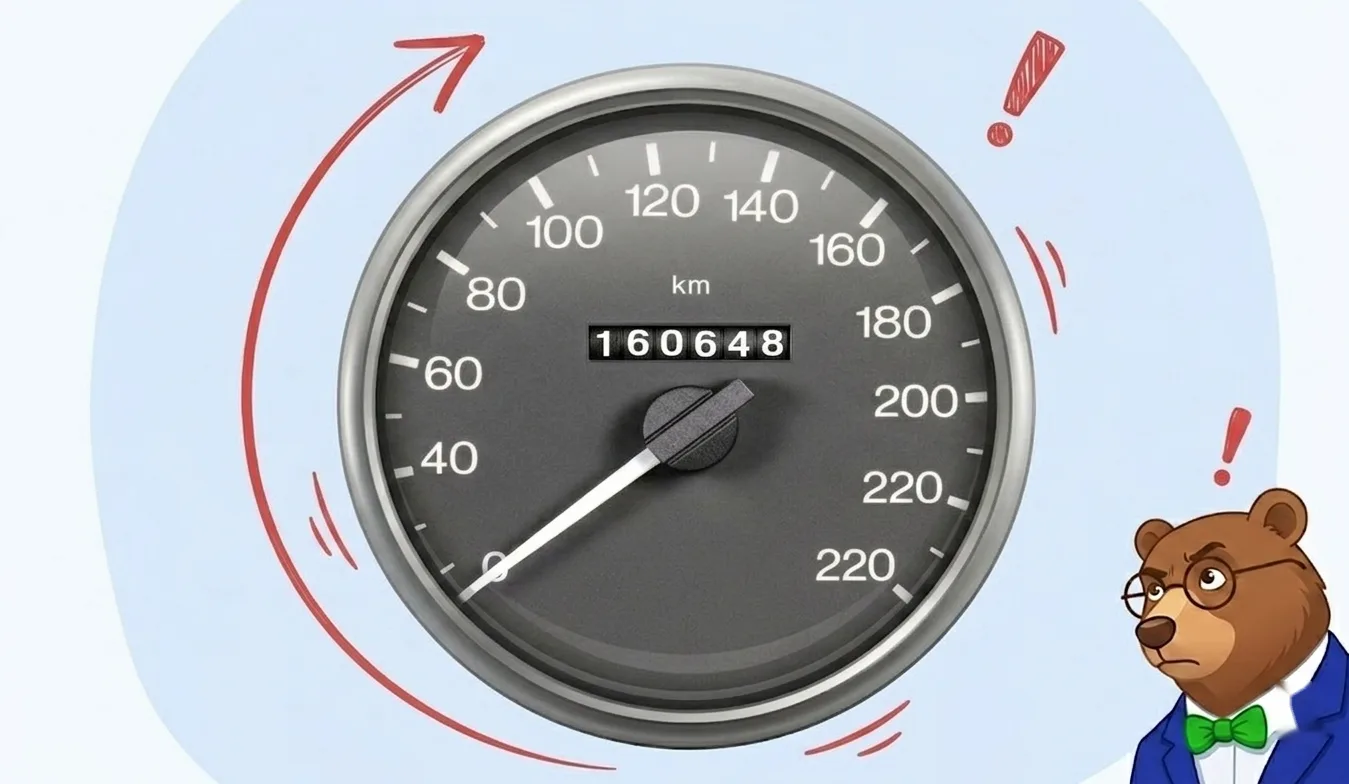
A low number on the dial is the easiest thing in the world to fake.
Buying a used car should feel like a win. But that feeling is exactly what the market is built to sell you: a large share of the cars changing hands across Europe carries a secret, be it a rolled back odometer, an undisclosed accident, or damage the seller would rather keep quiet. Here is what the research shows, and why checking a car's history before you pay is no longer optional.
The short version
- Up to half of imported used cars have had their mileage altered.
- Clocking is cheap, takes seconds, and in most of Europe is barely punished.
- It hides well, but wear, service records and logged readings give it away.
- Where every reading is recorded, like Belgium, the fraud almost disappears.

Check the VIN before you buy
See a car's real mileage, damage, finance and import history across 30+ countries, in under a minute.
Example: WBA3A5G59DNP26082Free preview included
Fake mileage is not rare. For some cars it is the norm.
Odometer fraud, or "clocking," is the quiet manipulation of a car's recorded mileage to make it look less used than it really is. It is one of the oldest tricks in the trade, and modern digital dashboards have made it easier than ever.
How common is it? A study commissioned by the European Parliament found that between 5 and 12 percent of cars sold within a single country have manipulated odometers. For cars sold across EU borders, that figure climbs to between 30 and 50 percent. In Germany, the largest used car market in Europe, ADAC estimates that roughly one in three used cars has had its mileage tampered with.
Where mileage fraud hides
Share of used cars with manipulated odometers, by type of sale (EU)
If you are buying an imported car, the odds that its mileage has been touched can be close to a coin flip.
This matters most in markets that rely on imported cars. A car driven hard for years in one country can cross a border, shed a third of its mileage on paper, and arrive looking like a careful, barely used bargain. The paperwork follows the car. The truth often does not.
How a car gets clocked
For most of motoring history, clocking meant physical work. An analog odometer is a set of mechanical number wheels driven by a cable, and rolling it back meant opening the dashboard and spinning the digits by hand, or running the cable backwards with a drill. It was slow work, and it often left the digits slightly misaligned.
Digital dashboards were supposed to end clocking. Instead they made it easier.
A modern car stores its mileage as a number in a small memory chip inside the instrument cluster. A device plugged into the car OBD diagnostic port, the same socket a mechanic uses, can read that number and overwrite it in seconds. ADAC notes these tools are sold openly for as little as 50 to 150 euros, and no mechanical skill is required.
There is, however, a catch that works in the buyer's favour. On many cars the mileage is not stored in one place. It is mirrored across several modules: the engine controller, the gearbox, the ABS unit, even the keys. A cheap tool usually rewrites only the dashboard. The original figure often survives elsewhere, which is exactly how a proper data check, or a careful workshop, can expose a number that was supposedly erased.
Clocking a car is really about inflating the price
Rolling back an odometer is not a harmless cosmetic tweak. It directly changes what you pay, because mileage is one of the biggest factors in a used car's value. Lower the number, raise the price.
The numbers are huge. ADAC calculates that clocking inflates a car price by an average of around 3,000 euros, with total damage to German buyers running into the billions every year. Across the EU, the European Parliament study estimated that odometer fraud costs consumers around 8.9 billion euros a year, and the authors said that is likely an underestimate. The pattern is not unique to Europe: in the United States, the NHTSA puts the cost at more than one billion dollars a year, with victims losing an average of around 4,000 dollars on a single clocked car.
The frustrating part: this problem is already solved
Here is what should make every car buyer angry. Odometer fraud is not an unstoppable force of nature. It is a problem that at least one country has very nearly eliminated.
Belgium offers the proof. Before it introduced a national mileage database, the country saw an estimated 60,000 to 100,000 cases of odometer fraud every year. Today, with every reading recorded and checkable through the official Car-Pass system, that number has collapsed. In 2024, out of nearly 22 million readings processed, Car-Pass flagged just 1,411 probable cases of fraud. The organisation now says clocking is almost gone in Belgium.
What transparency does to fraud
Odometer fraud cases per year in Belgium, before and after a national mileage database
The lesson is simple. When mileage is recorded often and made public, clocking stops working. Where it is not, fraud thrives, and checking is left to the buyer.
Mileage is only half the story
Even a genuine odometer tells you nothing about whether a car has been crashed, flooded, or rebuilt. Damage and financial history are the other great blind spots of the used car market, and they catch buyers out constantly.
In the UK, where vehicle checks are common, the numbers are grim. According to RAC and HPI data, around one in four cars put through a history check still has outstanding finance against it, meaning the car may not even be the seller's to sell. Roughly four percent have been written off after an accident or theft, and an estimated 384,000 cars are written off or seriously damaged every year. The AA, meanwhile, reports that one in eleven cars on UK roads shows a mileage that does not match its records.
The trouble with damage is that it leaves so few traces. A repaired accident leaves no smell. A rolled back odometer leaves no scratch. Flood damage can sit quietly under a fresh valet for months before the electronics begin to fail. The faults that matter most are exactly the ones a quick test drive will never reveal.
| Before you buy | Seller and test drive | With a history check |
|---|---|---|
| Real mileage | ×Trust the dial | ✓Verified |
| Accident and damage history | ×Hidden | ✓Revealed |
| Outstanding finance | ×Invisible | ✓Flagged |
| Import and ownership trail | ×Unknown | ✓Tracked |
How to protect yourself
You do not need to be a mechanic to buy safely. You need information, and you need it before you hand over any money. A few habits make a real difference. Treat a suspiciously low mileage on an older or imported car as a warning sign. Match the wear on the pedals, steering wheel, and seats against the number on the dash. Ask for a full, stamped service history and be careful when there are gaps in it. And most importantly, check the car's recorded history against its VIN before you commit to anything.
Do the maths before you fall in love with a car. Divide the mileage by the car's age: if the result is far below the roughly 10,800 kilometres a year the average European car covers, ask why, and treat a tidy dashboard with the same suspicion as a price that looks too good. Genuine bargains exist. So do stories that do not add up.
Is this mileage realistic?
Enter the car's details. We compare its mileage against what is typical for its age and use, show how far off it falls, and estimate the value at stake.
Benchmarks: the average car in the EU covers about 10,800 km a year, from roughly 6,000 km (Lithuania) to 17,000 km (Ireland), per ODYSSEE-MURE. The value estimate uses the rule of thumb that a used car's value moves about 4% per 10,000 km relative to average mileage, per Auto Express. These are rough guides only.
The bottom line
A confident seller and a tidy dashboard are not evidence. They are marketing. The only way to know what you are really buying is to look at the records behind the car: the mileage trail, the damage and accident history, any outstanding finance, and the import and ownership timeline.
A history check exists for one reason: the things that cost you most are the ones you cannot see in person. Whichever service you use, run the VIN before you sign. It takes a few minutes, and it turns a gamble into a choice you can stand behind.
Know before you buy
Mileage, damage, finance and import records across 30+ countries, in one report, in under a minute.
Not sure yet? See what a full report looks like first
Frequently asked questions
Is odometer fraud illegal?
Almost everywhere it is a form of fraud, but enforcement varies a lot from country to country. The European Parliament found that odometer tampering is a specific criminal offence in only six EU member states. Elsewhere it is usually treated as ordinary consumer fraud, which is harder to prove and rarely taken to court, so sellers have little to fear.
How can I tell if a car's mileage is genuine?
No single check is conclusive, but several together are powerful. Compare the reading against the wear on the pedals, steering wheel, gear knob and driver's seat. Cross check the service book stamps and any periodic inspection records, which note the mileage at each visit. A sudden flat spot, or a reading lower than an earlier record, is a warning sign. A recorded mileage history tied to the VIN is the most reliable single source.
What counts as normal mileage?
A rough European benchmark is around 10,800 kilometres per year, though it varies a lot by country. A ten year old car showing 40,000 km is not impossible, but it is unusual enough to deserve a closer look rather than excitement.
Does a digital dashboard make a car safer from fraud?
No. It is a common misconception. Digital odometers are generally easier and quicker to alter than old mechanical ones, because the figure can be rewritten through the diagnostic port in seconds.
How much mileage do fraudsters typically remove?
Enough to matter. In Belgium, where every reading is logged, the cases that are caught show an average rollback of nearly 100,000 kilometres, which can swing a car's value by thousands.
Are imported cars really riskier?
Yes. The European Parliament study put manipulation at 5 to 12 percent for domestic sales but 30 to 50 percent for cars sold across borders, because a car that changes country also loses the paper trail that would otherwise expose it.
Sources
- European Parliament: Odometer manipulation in motor vehicles in the EU (EPRS, 2018). 5 to 12% domestic and 30 to 50% across borders manipulation; €8.9bn annual cost. Read
- ADAC (Germany): around 1 in 3 used cars clocked; around €3,000 average price inflation; €50 to 150 tampering tools.
- Car-Pass (Belgium): annual report 2024. Fraud cut from 60,000 to 100,000 a year to 1,411 cases out of around 22m readings. Read
- NHTSA (USA): odometer fraud costs $1bn or more a year; around $4,000 average loss per car. Read
- RAC and HPI (UK): around 25% of checked cars carry outstanding finance; around 4% written off; around 384,000 written off or seriously damaged each year.
- The AA (UK): 1 in 11 UK cars shows a mileage discrepancy.
- ODYSSEE-MURE: average annual distance driven per car in the EU (around 10,800 km), used for the mileage calculator. Read
- Auto Express: rule of thumb that a used car's value moves around 4% per 10,000 km relative to average mileage. Read
Read next