
How to buy a car on Otomoto and find the actual deals
Otomoto has more than 234,000 used cars listed today. That is more choice than any buyer can realistically work through, which is why most people end up looking at whatever the site puts in front of them first.

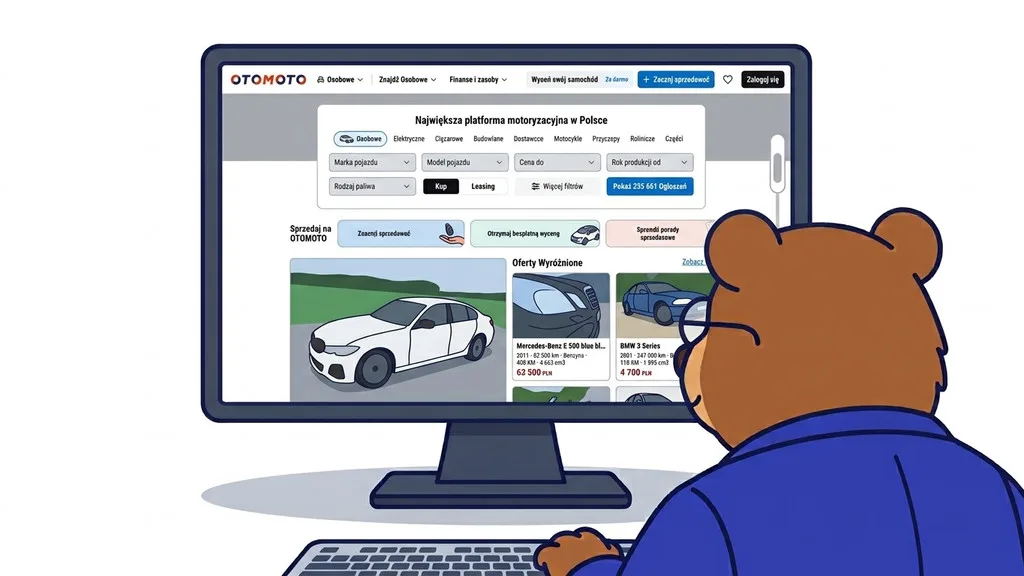
The order of the results is partly bought. One dropdown changes that.
Two things are worth knowing before you start. The order of the results is partly bought, and the history claims in the listings are not checked by anyone. Both are fixable in about a minute once you know.
The short version
What to remember
- Sorting by price or mileage removes paid promotion from the results.
- Bezwypadkowy and pierwszy właściciel are seller declarations, not verified facts.
- Good cars can disappear within minutes, so saved searches with alerts are often more valuable than browsing.
- Expect 5 to 15 percent of negotiating room, and the best buying window is late November into December.
- Check the country of origin filter. Roughly half of Polish imports come from Germany.
Skip ahead: check a car nowthe tax nobody budgets for
Check it before you call
A listing tells you what the seller says about the car. A history check tells you what happened before you spend time travelling to see it.
Example: WBA3A5G59DNP26082Free preview included
- 30+ countries
- Result in under a minute
- Full PDF report
Three sites, not one
Otomoto is the biggest marketplace, but it is not the only place where cars are listed. The same vehicle often appears on multiple platforms.
| Site | What it is | Why you would use it |
|---|---|---|
| Otomoto | 234,709 cars, about 5.95M monthly users | The default choice. Deepest dealer stock |
| OLX motoryzacja | About 4.55M monthly users | More private sellers, simpler listings, often lower prices |
| Autoplac | 185,000 cars, roughly 79% of Otomoto | Newer, growing quickly, worth checking as well |
Otomoto and OLX belong to the same group, so dealers often publish the same car on both platforms. The interesting difference is user behaviour. OLX has fewer users, but they view 74 pages each compared to Otomoto's 56. That is what a market looks like when the better listings are harder to spot and buyers spend more time searching.
Autoplac has grown enough that ignoring it means missing a significant part of the market. At 185,000 cars, it is no longer a niche platform.
The filters that do the work
Start with the mechanical filters, because they narrow the market in a straightforward way.
| Filter | What to do with it |
|---|---|
| Lokalizacja | Widen it. A two hour drive opens up a very different local market |
| Cena | Set a ceiling below your actual budget so there is room to negotiate upward if needed |
| Rok produkcji, przebieg | Narrow both, then widen one at a time to understand how the market prices them |
| Silnik i napęd | Engine size affects future tax and insurance costs |
| Dane sprzedającego | Prywatny, firma, leasing or faktura VAT. Do not exclude any category too early |
| Stan uszkodzeń | Nieuszkodzony or uszkodzony. A rare filter and a useful one |
| Zapisz filtry | Save the search. This is often what actually finds you a car |
Stan uszkodzeń deserves a closer look. Few marketplaces allow you to separate damaged and undamaged vehicles this clearly. If you are looking for a repair project, deliberately set it to uszkodzony. If you are not, use nieuszkodzony. Just remember that it reflects what the seller selected.
The first page is not the best page
This is something many buyers never realise.
Otomoto sells two promotional options to sellers. Wyróżnienie places a listing at the top of the results under a blue Wyróżnione banner. Podbicie pushes a listing just below those featured spots. Both influence the recommendation system behind the default Wybrane dla Ciebie view.
So the first screen you see is ordered partly by who paid for extra visibility.
Otomoto's own help pages explain how to switch that off. When you sort by a specific criterion such as lowest price, mileage or engine power, paid promotion and bumps stop affecting the position of listings. One dropdown converts an advert into a market.
| Sort by | What you actually get |
|---|---|
| Default, Wybrane dla Ciebie | Influenced by paid promotion and your browsing behaviour |
| Najniższa cena, przebieg, moc | Ranked by the car itself. Promotion no longer matters |
| Najnowsze | Uses the original publication date, not the bump date |
That last option matters more than it seems. Najnowsze uses the date the listing was first published, which means a seller cannot repeatedly bump a six week old listing into the newest results. Sorting by newest shows genuinely new stock.
How to search so you see what everyone else misses
Sorting fixes the order of what you are shown. This fixes what you are shown in the first place.
Search the same model more than one way. Sellers type what is quick, not what is correct. Citroen and Citroën, Skoda and Škoda, Megane and Mégane. A listing written without the diacritic and a listing written with one are not always found by the same search, and the sloppier spelling usually belongs to a private seller rather than a dealer.
Search the misspellings too. Golfa, Pasat, Insigna, Astry. A model name spelled wrong is a listing almost nobody has found, and it is still available for exactly that reason.
Browse the category, not just the model. Cars get posted under the wrong make, the wrong body style or with the model left out of the title entirely. Those listings are invisible to anyone searching properly, which is the whole point.
Widen the location before you narrow anything else. Two hours out is a different local market with different prices and far fewer people through the car.
Save the search and turn alerts on. On a correctly priced car, sellers report calls within minutes. Saved searches are not a convenience here, they are the difference between finding a deal and reading about one. The buyers who get those cars are not smarter than you. They are earlier.
The listings everyone else skips
A good advert and a good car are not the same thing, and on a marketplace where sellers pay to be seen, they are often the opposite.
| What it looks like | What it often means |
|---|---|
| Four dark photos taken in a yard | Someone who does not sell cars for a living |
| Three lines of description | The same seller, with no interest in marketing |
| No promotion, deep in the results | The seller did not pay for position, not that the car is worse |
| A misspelled or unusual title | Fewer people have found it |
| A round number price with no reasoning | Chosen by feeling, which means it can be changed by argument |
The professionally photographed listing with a Wyróżnione banner is competing for attention against every other buyer on the platform. The dark photograph of a clean Golf in a village driveway is competing against almost nobody.
The filters that are only opinions
Otomoto's Historia i stan section offers bezwypadkowy, pierwszy właściciel and kraj pochodzenia. They feel like some of the most valuable filters on the platform, but they are also among the least reliable.
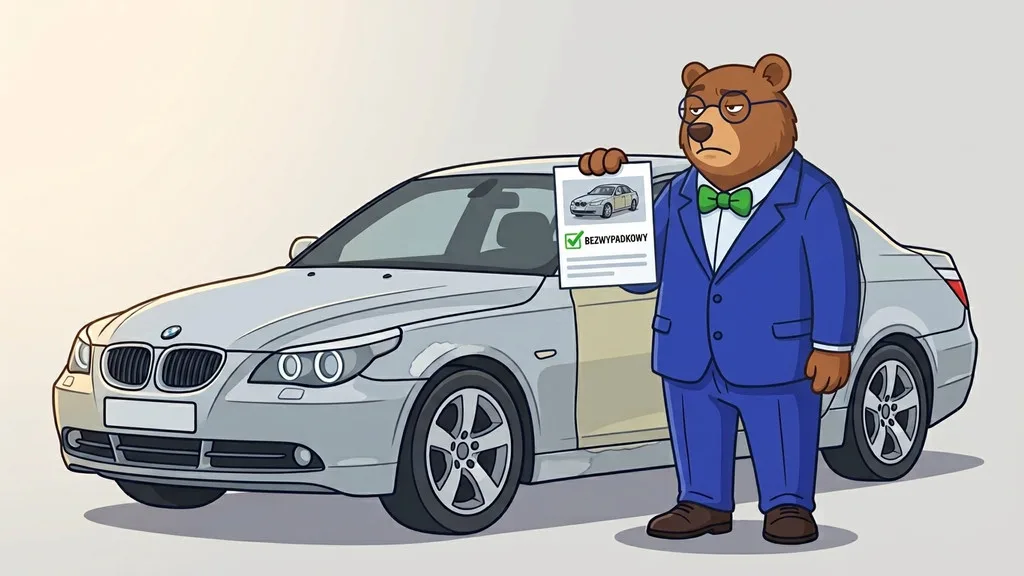
Each of these fields is completed by the seller. Otomoto does not independently verify them, and Polish coverage of the platform has repeatedly highlighted cases where listings described cars as bezwypadkowy despite later evidence of structural repairs.
Filtering for bezwypadkowy does not narrow you to accident free cars. It narrows you to sellers who typed the word.
Compare that with Germany, where filtering for a fresh HU means the car has been inspected by an engineer with no reason to favour the seller. The action looks similar, but the value is completely different. On Otomoto there is no equivalent verification built into the platform, which is why checking the VIN elsewhere before travelling to see a car matters so much.
Reading a Polish listing
The terminology creates the same problem, and two of the most common words are weaker than they sound.
| Term | What it means |
|---|---|
| Bezwypadkowy | No accident, claimed. Not verified, and not the same as bezkolizyjny |
| Bezkolizyjny | No collision, claimed. Often used to suggest smaller damage was acceptable |
| Powypadkowy | After an accident. Honest, and usually priced accordingly |
| Uszkodzony | Damaged now. What you see is what you are buying |
| Sprowadzony | Imported. Ask where from and when it was first registered locally |
| Pierwszy właściciel | First owner, claimed. Easy to check against the paperwork |
| Serwisowany w ASO | Serviced at an authorised dealer. Ask for records |
| Faktura VAT | VAT invoice available. Important for businesses, less so for private buyers |
| Do negocjacji | The seller already expects some movement on price |
Bezwypadkowy and bezkolizyjny are not the same thing, and sellers make use of that distinction. A car described as bezkolizyjny may still have had damage that the seller does not consider a collision. If the difference decides your purchase, verify it with a source outside the listing.
Spotting a dealer posing as a private seller
A large share of the cars advertised as private sales in Poland are not private sales. Trading through a private account avoids the obligations a business carries, and it hides how the car was acquired, which is usually the part worth knowing.
The tells are visible before you pick up the phone.
| Signal | What it usually means |
|---|---|
| One phone number across five to ten live adverts | A private person does not have a fleet |
| A link to the seller's other listings | A business account, whatever the advert says |
| Trade vocabulary with unusually polished photographs | Written and shot by someone who does this weekly |
| Offers part exchange with a top up, or financing | Private sellers do not take your old car |
| Handlarzom dziękuję in the description | Frequently written by dealers to pass as private |
That last row surprises most buyers. The phrase reads as a private seller warning traders off, which is exactly why traders use it.
Where the car came from
Kraj pochodzenia connects this marketplace to the wider used car market. Roughly half of Poland's imported used cars come from Germany, while the United States has become the fastest growing source, largely through salvage auctions.
The older a car is, the more history it has had time to accumulate. When that car has crossed a border, its history is split across two countries, only one of which a Polish seller can easily document.
This is not an argument against imported cars. Much of the best stock in Poland is imported. It is a reason to find out where a car spent most of its life before you agree a price, because that is where most of its records will be.
When to buy, and when to send the message
Two clocks matter. The season, and how long the advert has been sitting.
| Period | What happens |
|---|---|
| September to November | Peak demand and the firmest prices of the year. The worst window to buy |
| End of any month or quarter | Dealers chasing targets. The same effect in miniature |
| Late November into December | The strongest buying window. Sales targets are closing and the year is ending |
| Spring | Not cheaper, but longer light and dry roads mean you can actually inspect paint, glass and underbody |
Then there is the individual advert. A car that has been listed for a month has already taught its seller something about the price, and it costs nothing to ask. The message that works is short, specific and does not open with a number.
What the price should be
The asking price usually includes room for negotiation, and Polish sellers tend to leave more of it than German ones.
Realistic reductions run 5 to 15 percent. Five to ten on a well kept car, up to fifteen when it needs work or the advert has been sitting for over a month. Private sellers usually have less room than dealers but decide faster.
Prepare before you open. Price five to ten comparable adverts, anchor below your target, then say nothing after you name it. Silence does more work in a negotiation than argument does.
When the price genuinely will not move, stop pushing on price and ask for things instead. A second set of tyres, a fresh service or a full tank are cheap for the seller to give and worth real money to you.
Before negotiating, price the car properly. Compare the same model, year, engine and similar mileage across Otomoto, OLX and Autoplac, and use the cluster of comparable listings rather than the single cheapest example, because the cheapest listing is usually cheap for a reason that is not immediately obvious.
Then use the same lever that works almost everywhere: a written repair quote. A timing belt replacement, worn tyres or an expired inspection all have measurable costs, and numbers move prices in a way opinions do not.
The tax nobody budgets for
Buying from a private seller means PCC at 2 percent, declared on a PCC-3 form within 14 days of signing the contract. Buying from a company on a VAT invoice usually means no PCC at all, which narrows the gap between a private bargain and a dealer car more than most buyers expect.
The detail that catches people is the base. The tax is calculated on market value, not on the price written in the contract. Writing a low figure in the umowa does not reduce the tax. It invites the tax office to set its own valuation and add interest on the difference.
| You buy from | What you owe |
|---|---|
| A private seller | 2 percent of market value, PCC-3 within 14 days |
| A company, on a VAT invoice | Usually nothing |
| Anyone, below 1,000 zl | Exempt, which in practice means parts cars only |
The scams
The most common scam aimed at buyers follows a familiar pattern.
The car is priced well under a tight cluster of comparable vehicles. The seller quickly tries to move the conversation to WhatsApp or Telegram. They are conveniently abroad, often working or living in another country. They send photographs, documents that look legitimate and sometimes an invoice. Then they ask for a deposit to reserve the car or to arrange transport to Poland.
| Signal | What it means |
|---|---|
| Far under the cluster | Something is undisclosed, or the car does not exist |
| Seller abroad, car in storage | Usually a sign that there is no car |
| Pushes to WhatsApp or Telegram immediately | Wants to avoid a clear record |
| Deposit before viewing | Theft |
| Documents only as photographs | The documents may belong to another vehicle |
| Refuses a video call showing the VIN plate | Time to end the conversation |
One more point if you are selling rather than buying. There is a steady stream of phishing aimed at Otomoto sellers: fake messages from an Otomoto Security Team, SMS claiming a listing has been suspended over an unpaid balance, and fake login pages built to steal credentials. Otomoto never asks you to log into your bank to verify anything.
Before you pay
- Sort by price or mileage instead of accepting the default order.
- Save the search and enable alerts.
- Compare pricing across Otomoto, OLX and Autoplac before you contact the seller.
- Treat bezwypadkowy and pierwszy właściciel as claims to verify, not filters to trust.
- Ask where the car came from and when it was first registered in Poland.
- Get the VIN in writing and run a history check.
- Request a video call showing the VIN plate, dashboard and a cold start.
- Match the VIN on the car to the VIN on every document, in person.
- Get a repair quote for anything visible and use it in the negotiation.
- Budget PCC at 2 percent of market value if you are buying privately.
- Never send a deposit for a car you have not stood next to.
The asking price is the number everybody argues about. The order of the results, the words in the listing and the tax afterwards are where the rest of the money goes.
Before you sign anything
Know what you are buying
Mileage, damage, finance and import records across 30+ countries, in one report, in under a minute.
- 30+ countries
- Under a minute
- Full PDF report
Not sure yet? See what a full report looks like first
Frequently asked questions
Does bezwypadkowy on Otomoto mean the car has never been in an accident?
No. Bezwypadkowy is a field the seller fills in, and Otomoto does not verify it. Filtering for it narrows you to sellers who typed the word, not to cars with a clean history. It is also not the same as bezkolizyjny, which sellers use when they do not consider the damage a collision. If the answer decides your purchase, check the VIN against records outside the listing.
How do I stop paid promotion from deciding what I see on Otomoto?
Sort the results. Otomoto's own help pages state that when you sort by a specific criterion such as lowest price, mileage or engine power, paid promotion and bumps stop affecting position. The default Wybrane dla Ciebie view is influenced by both. Sorting by Najnowsze also uses the original publication date rather than the bump date, so a repeatedly bumped old listing cannot pose as new stock.
How much can you negotiate off a car on Otomoto?
Realistically 5 to 15 percent. Five to ten on a well kept car, up to fifteen when it needs work or the advert has been sitting for over a month. Private sellers usually have less room than dealers but decide faster. A written repair quote moves the number in a way an opinion does not.
Do I pay tax when I buy a car privately in Poland?
Yes. Buying from a private seller means PCC at 2 percent, declared on a PCC-3 form within 14 days of signing the contract. Buying from a company on a VAT invoice usually means no PCC at all. The tax is calculated on market value, not on the figure written in the umowa, so understating the price invites the tax office to set its own valuation and add interest.
How do I tell a dealer posing as a private seller on Otomoto?
One phone number across several live adverts, a link to the seller's other listings, trade vocabulary with unusually polished photographs, or an offer of part exchange or financing. The phrase Handlarzom dziękuję is written by dealers often enough that it is a weak signal at best. The question that settles it is whose name is on the dowód rejestracyjny.
Is it worth checking OLX and Autoplac as well as Otomoto?
Yes, for pricing. Otomoto and OLX belong to the same group and dealers often publish the same car on both, but Autoplac now carries around 185,000 cars, which is roughly 79 percent of Otomoto's stock. Pricing a model across all three gives you a cluster of comparable listings rather than one platform's view of what it is worth.
About this guide
- Scope: listing counts are live figures from Otomoto and reported figures for Autoplac, and both move daily. Traffic comparisons come from Polish industry measurement and are directional rather than current.
- PCC and registration: the 2 percent rate, the 14 day PCC-3 deadline and the market value basis are the published rules, and the exemption threshold is worth confirming for the year you are buying in.
- Listing terms: the local words are left exactly as they appear on the platform, because a translated term cannot be searched for. The condition and history fields in particular are seller declarations, not verified facts.
- Negotiating ranges and seasonal patterns: typical estimates rather than rules. They move with the model, the season, the seller and how long the advert has been up, and are worth treating as a starting point rather than a target.
- Why the VIN matters here: a border crossing is where a car paper trail usually goes missing, covered in how to check an imported car, and the mileage side in odometer fraud. If the car you are looking at came from Germany, the import guide for this market covers what it costs to bring one over yourself.
Read next