
How to find the best deals on Hasznaltauto.hu
Hasznaltauto.hu is not just the biggest car marketplace in Hungary. For practical purposes, it is the market. The Central Statistical Office publishes a monthly release built on its listing data, which is not something a country does with a website it considers one option among several.

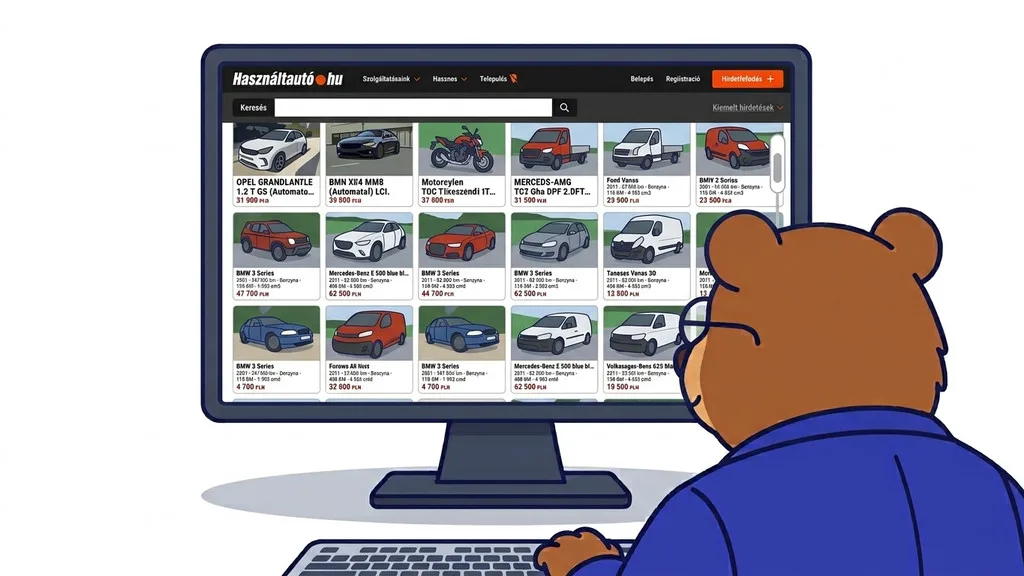
The Hungarian record starts the day the car arrives. Most of these cars are older than that.
Around 110,000 cars are listed at any given time. By European standards that is not a huge pool, and it changes how you should approach buying. Instead of filtering down through endless options, success usually comes from reacting quickly when the right car appears.
Before you start, two things are worth knowing. The Hungarian state already checks more than most countries do, and those checks stop at the Hungarian border.
The short version
What to remember
- Transfer duty depends on engine power and age, so compare kW figures before you compare prices.
- Állapot is a category chosen by the seller. Sérülésmentes is a description, not proof.
- Eredetiségvizsgálat is compulsory when ownership changes and checks identity, not condition.
- JSZP on magyarorszag.hu provides recorded odometer readings free of charge from 2013 onward.
- Those records begin when the car was registered in Hungary. For an import, that can be a small part of its life.
- 75,562 used cars were imported in the first half of 2026, an increase of 22.4%.
Skip ahead: check a car nowthe free checks

The years before Hungary
The Hungarian record starts when the car was registered here. A cross border check covers the years before that, which is where most of the history sits.
Example: WBA3A5G59DNP26082Free preview included
- 30+ countries
- Result in under a minute
- Full PDF report
Where the stock actually is
Használtautó.hu is so dominant that the second place worth checking is often not another Hungarian marketplace at all. It is Germany.
| Where | What it is | Why you would use it |
|---|---|---|
| Használtautó.hu | About 110,000 cars, the reference point for national statistics | The default choice and, for most buyers, the only domestic search they make |
| Jófogás | General classifieds with a vehicle section | More private sellers and occasional local bargains |
| AutoScout24.hu, mobile.de | German inventory that eventually finds its way into Hungary | The source of a large share of Hungarian supply before it arrives |
That third row is the honest one. Hungarian supply and German supply are closely connected. Imports have been running above 12,000 cars per month for four consecutive months, levels not seen in seven years. A car listed in Budapest next spring may very well be a car that was advertised in Germany this autumn.
The filters that do the work
| Filter | What to do with it |
|---|---|
| Ár | Set a ceiling below your actual budget so you still have room to move |
| Évjárat, Futásteljesítmény | Narrow both aggressively, then relax one at a time |
| Kivitel, Hajtás | Body style and drivetrain reduce the search honestly |
| Üzemanyag, Hengerűrtartalom | Engine size affects ownership costs, not just performance |
| Állapot | Useful, but read the next section before trusting it |
| Megye | Widen it. Hungary is small, and two hours can put you in a completely different market |
| Értesítés | Save the search and enable alerts. In a smaller market this matters more than browsing |
With around 110,000 cars available, a well designed saved search is not a convenience. It is most of the method.
How to search so you see what everyone else misses
Filters decide what you are shown. This decides what you are shown in the first place.
Search the model more than one way. Hungarian sellers type what is quick. Skoda and Škoda, Citroen and Citroën, VW and Volkswagen, Passat and Pasat. The spellings do not always return the same listings, and the careless one usually belongs to a private seller rather than a dealer.
Browse the category, not just the model. Cars get posted under the wrong make, the wrong body style or with the model missing from the title. Those listings are invisible to anyone searching properly, which is exactly why they are still there.
Widen Megye before you narrow anything else. The country is small and two hours is a different price level, with far fewer people through the car.
Save the search and turn on Értesítés. On a pool of this size, a correctly priced car does not sit for a week. The buyers who get those cars are not smarter than you. They are earlier.
The listings everyone else skips
A good advert and a good car are not the same thing, and on a marketplace where sellers pay for visibility they are often the opposite.
| What it looks like | What it often means |
|---|---|
| Four dark photos taken in a yard | Someone who does not sell cars for a living |
| Three lines of description | The same seller, with no interest in marketing |
| No highlight, deep in the results | The seller did not pay for position, not that the car is worse |
| A misspelled or unusual title | Fewer people have found it |
| A round number price with no reasoning | Chosen by feeling, which means it can be argued with |
Where the value actually is
Start with the numbers. Hungary is unusual because the market publishes its own averages every month together with the statistical office, so you do not need to guess what the broader market looks like.
Those figures are worth reading together. Prices increased, but the cars did not become newer or lower mileage. That points to supply pressure rather than better stock, which means waiting for the market to become dramatically cheaper is unlikely to be a winning strategy. The advantage comes from choosing well, not from timing.
One thing the platform does help with is sorting. Results are displayed in ascending price order by default, so you begin at the cheaper end of the market rather than looking at listings ranked by hidden factors. The challenge is not finding cheap cars. It is working out which of them are worth buying.
Know which shelf you are shopping on
The market breaks into four price bands, and each behaves differently.
| Price band | Share of listings | What it means for you |
|---|---|---|
| Under 2.5 million Ft | About 39% | The busiest part of the market. Cars move quickly |
| 2.5 to 5 million Ft | About 27% | Plenty of choice and the widest range of conditions |
| 5 to 10 million Ft | About 21% | Fewer buyers and often more willingness to negotiate |
| Over 10 million Ft | About 13% | Thin supply, longer listing times and more negotiating room |
If your budget sits close to one of these boundaries, it is worth looking slightly above it. The cheaper shelf is where everyone else is standing.
The kW question nobody asks until it is too late
Transfer duty in Hungary is not a fixed fee. It is based on engine power in kilowatts multiplied by a rate that depends on the car's age, ranging from roughly 300 to 950 forint per kW. More power means a bigger bill, and the rate falls as the car gets older.
For example, an 85 kW car that is five years old carries approximately 63,750 Ft in transfer duty, plus around 24,975 Ft for the compulsory identity check and another 12,000 Ft for registration documents.
Look where supply just grew
New supply creates choice, and choice improves your position as a buyer. Hybrid listings grew by more than 40 percent in a single year. That part of the market now offers significantly more depth than before. Expanding segments are where patient buyers tend to do best.
Spend money to save money
An independent pre purchase inspection is one of the best investments you can make in the entire process.
The cost is small compared with a major repair bill. More importantly, it does two things at once. It tells you whether to walk away, and if you decide to proceed, it gives you a written list of faults that is much harder for a seller to dismiss than your personal opinion.
Állapot is an adjective
The condition field is a dropdown menu selected by the seller. The options are Normál, Kitűnő, Megkímélt, Újszerű and Sérülésmentes.
Notice what those words are doing. Four describe how the car appears today. The fifth makes a statement about history, yet it is selected in exactly the same way as the others and verified by nobody.
That is where buyers get caught out. Sérülésmentes sounds like evidence of an accident free history, and it is not. It is a category chosen by the seller to describe the vehicle. Használtautó.hu does not verify it, and nothing later in the transaction confirms it either.
Filtering for Sérülésmentes only narrows the results to sellers who selected that label.
Reading a Hungarian listing
| Term | What it means |
|---|---|
| Sérülésmentes | Undamaged, according to the seller. A dropdown choice, not a finding |
| Sérült | Damaged now. Honest about the current condition |
| Megkímélt | Well looked after. Entirely subjective |
| Vezetett szervizkönyv | Stamped service book. Ask to see every page |
| Első tulajdonos | First owner. Verify against the forgalmi |
| Frissen műszakizva | Fresh inspection. Ask who performed it and when it expires |
| Magyarországi | Hungarian from new. This affects what state records can tell you |
| Friss import | Recently imported. Ask where from and request the foreign paperwork |
| Alkatrésznek | For parts. Not a road car regardless of how it looks in photos |
Magyarországi and friss import are the two terms that matter most, not because of the car itself, but because they determine how much history the Hungarian system can show you.
The dealer who says he is private
This one costs money rather than dignity. Under Hungarian rules the seller is liable for hidden faults for one year when the seller is a private person and two years when the seller is a business. A trader advertising from a private account is quietly halving the cover you are buying with the car.
The vocabulary gives them away before the phone call does.
| Signal | What it usually means |
|---|---|
| Hitelre is | Financing offered. Private people do not arrange credit for you |
| Autóbeszámítás | Part exchange. Private people do not want your old car |
| Several phone numbers on one advert | A business with staff |
| Névre írva | Typical of traders who specialise in grey imports |
| The seller is not the registered owner | Selling on someone else's behalf, whatever the account says |
There is a second consequence worth knowing, and it points straight back at the advert text. A seller is not liable for a fault they disclosed before the sale. Anything named in the listing or mentioned in writing is a fault you accepted. Anything they left out is a fault they still owe you for, which is a good reason to keep the advert and the messages.
The checks worth running before you travel
Two checks cost almost nothing and both are worth doing before you spend a Saturday on the road.
| Check | Cost | What it gives you |
|---|---|---|
| JSZP, magyarorszag.hu | Free, needs an Ügyfélkapu login | Hungarian registration history and odometer readings recorded since 2013 |
| Eredetiségvizsgálat | 23,000 Ft to 27,000 Ft, compulsory at transfer | That the car matches its documents and is not recorded as stolen |
Run JSZP first, because it is free and it takes a minute. If a later odometer reading is lower than an earlier one, or the mileage barely moves across several years, you have saved yourself the trip.
The eredetiségvizsgálat happens anyway when the car changes hands, with a few exceptions such as transfers between close relatives, and buyer and seller commonly split the fee. It is a strong check of identity, not condition. It confirms the car is the car the papers describe. It does not tell you the gearbox is tired.
What the price should be
Negotiating room is generally smaller here than in larger neighbouring markets. Supply is tighter, and buyers already face unavoidable transfer costs.
The realistic range depends entirely on who you are buying from. A private seller rarely moves more than 5 to 10 percent. A dealer will often go 10 to 15 percent, and occasionally further on a car that has been sitting or was optimistically priced to begin with. A car priced correctly in the first place barely moves at all, from either.
The strongest negotiating points are the ones with a clear cost attached: an expiring műszaki, worn tyres, a timing belt that is due. Get them in writing and subtract them.
Compare the car against a group of similar listings rather than the single cheapest example. Then treat the transfer costs and the eredetiségvizsgálat fee as part of the overall purchase price.
The fifteen day clock
The paperwork after the handshake runs on a deadline, and missing it is expensive in a way nothing else in this article is.
| Who | Deadline | What happens |
|---|---|---|
| Buyer | 15 calendar days from signing | Register the car in your name |
| Seller | 8 calendar days from signing | Report the change of ownership |
| Late buyer | After day 15 | A tax authority fine that can reach 100,000 Ft, and the car can be withdrawn from circulation |
They are calendar days, not working days. Weekends and public holidays count, which is how a purchase made on a Friday before a long weekend quietly loses four of its fifteen days. Buy the car and book the transfer in the same week.
The scams
Two patterns are worth recognising. The second is particularly common in this market.
The classic scam is familiar. The car is priced far below comparable listings, the seller quickly moves the conversation to a messaging app, claims to be abroad and asks for a deposit to reserve or transport the vehicle.

The local version is more subtle. A recently imported vehicle is cleaned up and advertised as Sérülésmentes, without much discussion of where it came from. Nothing stated is necessarily false. The seller simply allows the short Hungarian history to stand in for a much longer foreign one.
| Signal | What it means |
|---|---|
| Far under the cluster | Something is missing from the story, or there is no car |
| Deposit before viewing | Theft |
| Pushes you to a messaging app immediately | Wants no clear record |
| Vague about the country of origin | The important years may be the ones being skipped |
| Refuses a video call showing the VIN plate | Time to walk away |
| Recently imported with no foreign documents | Ask again and leave if the answer remains vague |
Before you pay
- Save the search and enable alerts. Good cars move quickly.
- Treat Állapot and Sérülésmentes as seller descriptions, not findings.
- Compare kW figures as well as asking prices. Transfer duty depends on power and age.
- Ask directly whether the car is Magyarországi or imported, and from where.
- Run the free JSZP check and look for odometer inconsistencies.
- Get the VIN in writing and investigate the years before Hungary.
- Ask for a video call showing the VIN plate, dashboard and a cold start.
- Match the VIN on the car to the VIN on the forgalmi in person.
- Include the transfer costs and the eredetiségvizsgálat fee in your calculations.
- Get a written repair quote for visible faults and use it during negotiations.
- Book the transfer inside 15 calendar days of signing. Weekends count.
A thin market rewards the buyer who is ready, not the one who waits. The kW figure, the origin question and the fifteen day clock are the three numbers to settle before you agree anything.
Before you sign anything
See the years before Hungary
Mileage, damage, finance and import records across 30+ countries, in one report, in under a minute.
- 30+ countries
- Under a minute
- Full PDF report
Not sure yet? See what a full report looks like first
Frequently asked questions
Does sérülésmentes on Használtautó.hu mean the car has never been damaged?
No. Sérülésmentes is one option in the Állapot dropdown, chosen by the seller in exactly the same way as Normál or Kitűnő. Four of those options describe how the car looks today. Sérülésmentes makes a claim about its history, and nobody verifies it. Filtering for it narrows the results to sellers who selected that label.
How much is the transfer duty on a used car in Hungary?
It is engine power multiplied by an age dependent rate, roughly 300 to 950 forint per kW, and the rate falls as the car gets older. An 85 kW car five years old works out at about 63,750 Ft, plus around 24,975 Ft for the compulsory eredetiségvizsgálat and another 12,000 Ft for the documents. Compare the kW figure before you compare asking prices.
What does the free JSZP check on magyarorszag.hu show?
Hungarian registration history and the odometer readings recorded since 2013, free, with an Ügyfélkapu login. Run it before you travel: if a later reading is lower than an earlier one, or the mileage barely moves across several years, you have saved yourself the trip. It only holds what was recorded in Hungary, so on a recent import it is the last chapter of the story.
Is the eredetiségvizsgálat a condition check?
No. It is an identity check. It confirms the car is the car the papers describe and is not recorded as stolen. It costs roughly 23,000 to 27,000 Ft, is compulsory when ownership changes apart from a few exceptions such as transfers between close relatives, and buyer and seller commonly split the fee. It will not tell you the gearbox is tired.
How long do I have to register a car I have just bought in Hungary?
15 calendar days from signing for the buyer, and 8 for the seller to report the change of ownership. They are calendar days, not working days, so a Friday purchase before a long weekend quietly loses several of them. Missing the deadline risks a fine that can reach 100,000 Ft and the car being withdrawn from circulation.
How much can you negotiate on Használtautó.hu?
Less than in the larger neighbouring markets. A private seller rarely moves more than 5 to 10 percent. A dealer will often go 10 to 15 percent, and occasionally further on a car that has been sitting. A car priced correctly to begin with barely moves at all. The strongest arguments are the ones with a cost attached: an expiring műszaki, worn tyres, a timing belt that is due.
About this guide
- Scope: listing volumes and market figures come from Használtautó.hu releases and Hungarian registration statistics for 2026. Fleet age and import figures are national statistics, and all of them move month to month.
- Fees and deadlines: the duty rate per kW, the eredetiségvizsgálat fee and the rules on when one is required should be confirmed against current official sources before you budget from them.
- Listing terms: the local words are left exactly as they appear on the platform, because a translated term cannot be searched for. The condition and history fields in particular are seller declarations, not verified facts.
- Negotiating ranges and seasonal patterns: typical estimates rather than rules. They move with the model, the season, the seller and how long the advert has been up, and are worth treating as a starting point rather than a target.
- Why the VIN matters here: a border crossing is where a car paper trail usually goes missing, covered in how to check an imported car, and the mileage side in odometer fraud. If the car you are looking at came from Germany, the import guide for this market covers what it costs to bring one over yourself.
Read next