
Euro emission standards: which one does your car meet?
The Euro standard is the exhaust limit a car was approved to when it was new. It is recorded in the car's papers, and many cities use it to decide which cars may enter.

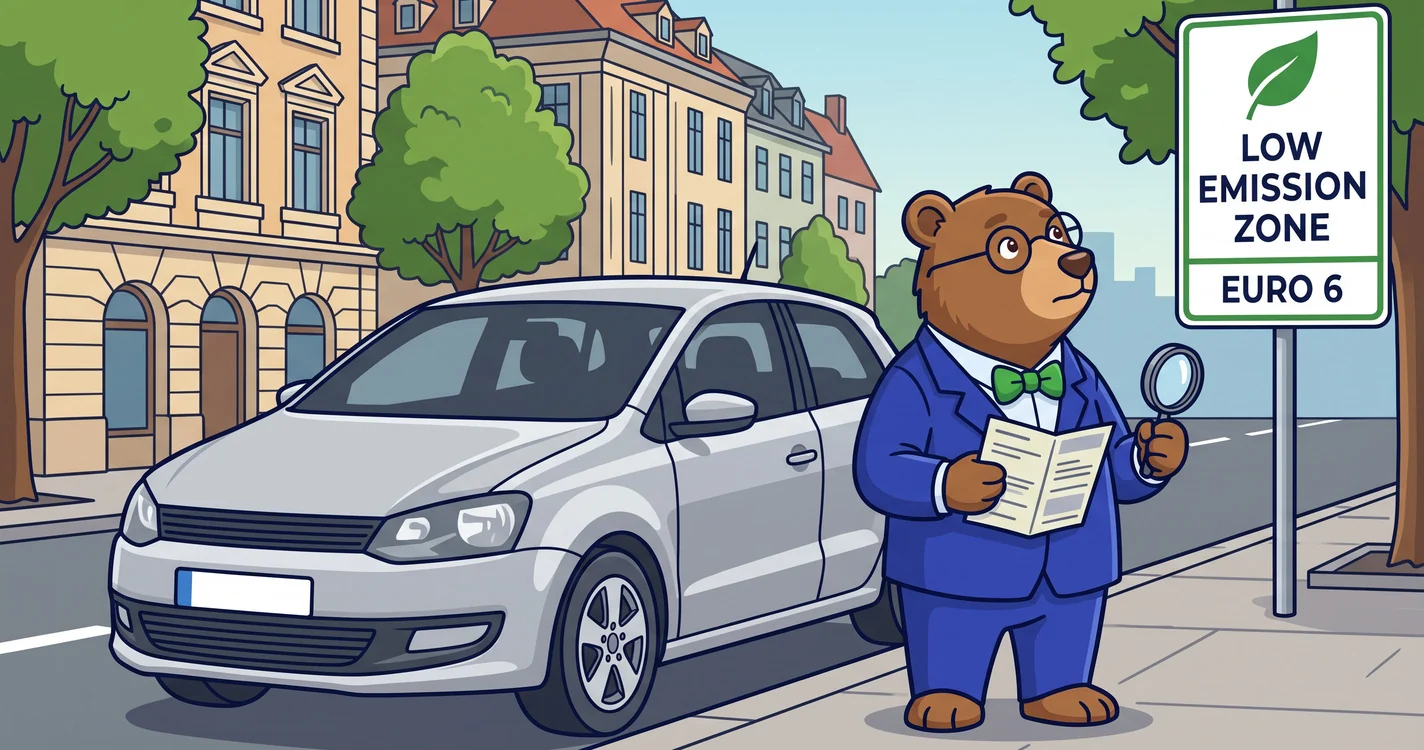
The class is one line in the papers, and it decides where the car may drive.
Two cars of the same model and year can carry different Euro classes.
One may drive into a city centre and the other may be fined there. The only difference is one line in the paperwork.
**The short version**
- Euro standards are EU limits on what a new car may emit from its exhaust. A higher number means stricter limits.
- Every new car had to meet Euro 4 from 2006, Euro 5 from 2011, Euro 6 from September 2015 and Euro 7 from November 2027.
- The class is in the registration document, in field V.9, where the country prints it.
- The year of first registration is only a rough guide. A car from 2010 can be Euro 4 or Euro 5.
- Low emission zones in many cities decide entry by Euro class and fuel, so check the class before you buy.
Skip ahead: the timeline, find your car's class, on a used car and check a VIN
Does the car's story match the ad?
The Euro class tells you how the car was approved. A history report shows what was recorded afterwards, such as import records and mileage readings.
Example: WBA3A5G59DNP26082Free preview included
- 30+ countries
- Result in under a minute
- Full PDF report
What the Euro standards are
Since 1992, EU law has capped what a new car may emit from its exhaust: carbon monoxide, hydrocarbons, nitrogen oxides (NOx) and particles.
Every few years the limits were tightened, and each new set got the next number.
The class belongs to the car as it was approved. A Euro 4 car from 2007 is still a Euro 4 car today.
Each standard arrived in two steps: first for newly approved models, then for every new car sold. The second step came about a year later.
Euro 1 to Euro 7 at a glance
The year shown is the one from which every new car had to comply.
- Euro 1, 1993: the first of the numbered standards, for every new car put on the road.
- Euro 2, 1997: tighter limits for petrol and diesel cars.
- Euro 3, 2001: NOx gets its own limit for the first time.
- Euro 4, 2006: the diesel limits for NOx and particles are halved.
- Euro 5, 2011: the diesel particle limit falls by 80%, which made particulate filters standard on diesel cars.
- Euro 6, 2015: the diesel NOx limit falls from 180 to 80 mg/km.
- Euro 6d, 2021: the same limits, now also checked in a test on the road.
- Euro 7, 2027: for newly approved models from 29 November 2026 and for every new car from 29 November 2027. It adds limits for brake particles and rules on battery durability.
How much stricter each step is
The biggest changes were for diesel cars. From Euro 3 to Euro 6 the NOx limit fell by 84% and the particle limit by 91%.
| Standard | Diesel NOx | Diesel particles | Petrol NOx |
|---|---|---|---|
| Euro 3 | 500 | 50 | 150 |
| Euro 4 | 250 | 25 | 80 |
| Euro 5 | 180 | 5 | 60 |
| Euro 6 | 80 | 4.5 | 60 |
Limits for passenger cars, in milligrams per kilometre.
For years these limits were measured only in a laboratory. Euro 6d added a test on the road, so "Euro 6" in an ad can mean an early version or the stricter 6d. Ask which one it is.
How to find your car's Euro class
- Registration document: the EU format has a field for the environmental category, V.9. Printing it is optional, so some countries leave it out and some show the number of the EU rule the car was approved under.
- Certificate of conformity: the carmaker's document for the car states the exhaust emission level as "Euro" and a number. It helps most with imported cars.
- First registration date: a rough guide only. Euro 5 applied to newly approved models from September 2009 and to every new car from January 2011, so a car first registered in 2010 can be Euro 4 or Euro 5.
A rule number is not always a class. Directive 98/69/EC covers both Euro 3 and Euro 4, and Regulation 715/2007 covers both Euro 5 and Euro 6.
If the papers show only the rule number, ask the seller for the certificate of conformity.
Petrol, diesel and hybrids
For petrol cars the steps were smaller. The NOx limit went from 80 mg/km under Euro 4 to 60 mg/km under Euro 5 and Euro 6.
For diesel cars the class tells you what hardware to expect. Euro 5 made a particulate filter standard, and many Euro 6 diesels add an AdBlue system to reach the NOx limit.
Ask about those parts at every viewing, because the car only meets its class while they work.
Euro 6 also set a particle limit for petrol engines with direct injection, which is why some newer petrol cars have a particle filter too.
A hybrid has a combustion engine, so it has a Euro class like any other car. A fully electric car has no exhaust.
Why the class matters
- Low emission zones: many cities decide entry by Euro class. In Germany the green sticker needs a diesel that meets the Euro 4 limits, and in France the Crit'Air sticker follows the car's Euro standard and its fuel. Rules differ by city and change over time.
- Inspection: at the periodic roadworthiness test, emission control equipment that is missing or obviously defective counts as a defect.
- Resale: a class that a nearby city is about to shut out gives local buyers a reason to bargain or walk away.
Two cars of the same model and year can carry different Euro classes.
On a used car: when the papers and the car disagree
The class in the papers describes the car as it left the factory. It does not tell you what was done to it later.
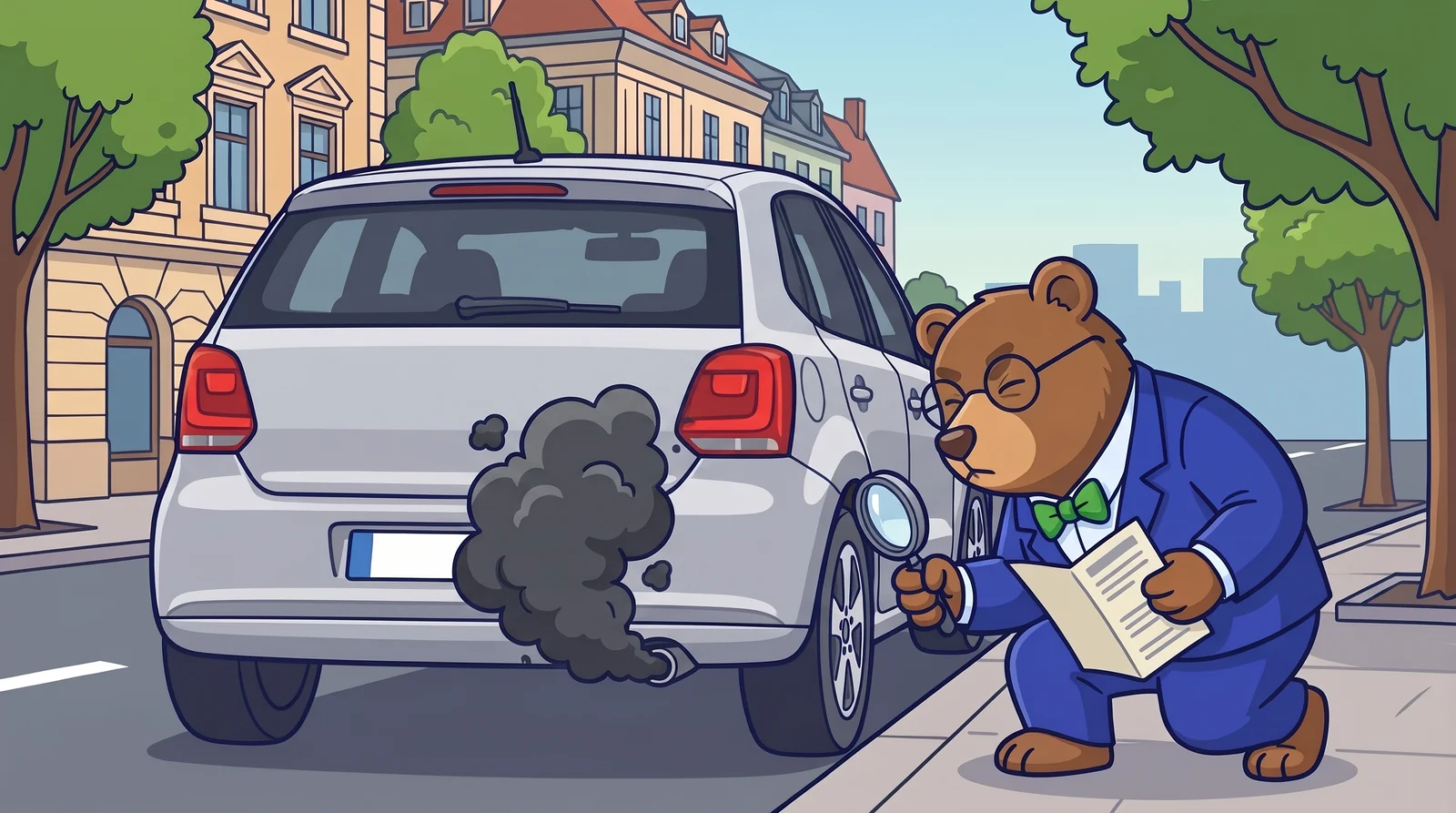
- Removed or switched off emission systems: EU lawmakers call the removal or deactivation of pollution control parts a well known problem. A diesel without its particulate filter, or with its AdBlue system switched off, is still Euro 5 or Euro 6 on paper but no longer meets the limits.
- The year in the ad: a year alone tells you little. Ask for the date of first registration and for the class in the papers.
- Imports: a car first registered in another country may show the class in a different form, or not at all.
**What to do before you buy**
- Ask for a photo of the registration document before the viewing.
- Read the class, or the rule number, and compare it with the date of first registration.
- Look up the low emission zone rules where you live and where you drive often.
- Check the VIN. Import records and mileage readings show whether the car's story matches the ad.
- On a diesel, ask whether the particulate filter and the AdBlue system are original and working, and have a garage confirm it.
The class in the papers describes the car as it left the factory.
A history report cannot measure emissions, so it will not tell you whether the filter is still in the car.
It shows what was recorded about the car over the years, such as import records and mileage readings from official registries and licensed sources.
If the records show the car came from another country, ask for the papers it arrived with.
What a history report adds, and what it cannot show
The Euro class is read from the registration document or the certificate of conformity, and a history report does not replace them.
It shows what was recorded about the car over the years. You can see what a full report looks like in our sample report, or decode what the car is with the free VIN decoder.
When the seller won't give you the VIN
A VIN is not a secret. On many cars you can read it through the windscreen.
Still comparing cars? You can buy reports now and use them once you have the VINs.
Before you meet the seller
Check the car behind the Euro class
Damage, mileage, auction and import records across 30+ countries, in one report.
- 30+ countries
- Under a minute
- Full PDF report
Not sure yet? See what a full report looks like first
Frequently asked questions
What is the difference between Euro 5 and Euro 6?
The main difference between Euro 5 and Euro 6 is the diesel NOx limit, which fell from 180 to 80 mg/km. For petrol cars the NOx limit stayed at 60 mg/km.
Is a 2010 car Euro 4 or Euro 5?
A car first registered in 2010 can be either Euro 4 or Euro 5. Euro 5 applied to newly approved models from September 2009 and to every new car from January 2011, so check the registration document.
When did Euro 6 start?
Euro 6 applied to newly approved models from September 2014 and to every new car from September 2015.
What does Euro 6d mean?
Euro 6d is the version of Euro 6 that also tests emissions on the road. It applied to newly approved models from January 2020 and to every new car from January 2021.
Where is the Euro class on the registration document?
The EU registration document has field V.9 for the car's environmental category. Printing it is optional, so some countries show the number of the EU rule there, or nothing.
Does Euro 7 ban older cars?
Euro 7 does not ban older cars. It applies to newly approved models from 29 November 2026 and to every new car from 29 November 2027, and which cars may enter a city is decided locally.
Sources
- Regulation (EC) No 715/2007 on Euro 5 and Euro 6, and Regulation (EU) No 459/2012
- Directive 98/69/EC on Euro 3 and Euro 4, and Directives 91/441/EEC and 94/12/EC
- Regulation (EU) 2017/1151 on emission tests and Regulation (EU) 2024/1257 on Euro 7
- Directive 1999/37/EC on registration documents and Directive 2014/45/EU on roadworthiness tests
- Germany's 35th Federal Immission Control Ordinance, the French government's Crit'Air pages and European Commission press release IP/06/1800
Read next